The oasis of Kashgar, with a view of the last peaks of the western Himalayas, is the last stop in China on the Silk Road. From here you can cross to Pakistan over the Karakoram Highway or to Kyrgyzstan over the Torugart Pass.
Kashgar is famous for its Sunday livestock market. It is big — no, it is huge. You will feel like you are back in the heyday of the Silk trade. Everywhere, donkeys are sold and taken for a test drive, sheep are bought and put on the back of a bicycle to take them home. Fur hats, silver daggers, and ancient Korans are on display in small shops. Men and women shout as they haggle over prices.
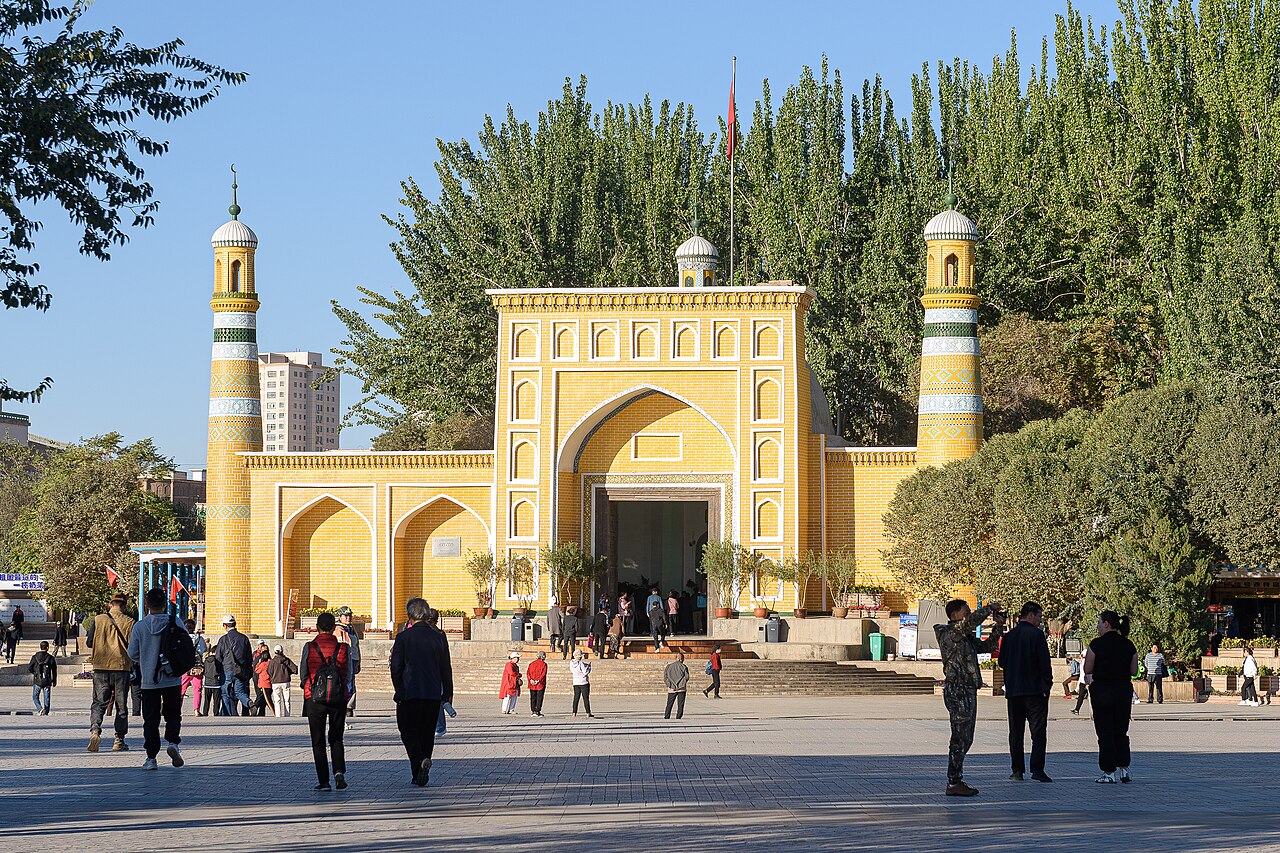
The old town (Kona Sheher), centred on the Id Kah Mosque, is one of the few remaining Uyghur neighbourhoods in Xinjiang that still has something of its original character, though much has been rebuilt. The Afaq Khoja Mausoleum — the holiest Islamic site in Xinjiang, with its brilliant tiled dome — lies five kilometres northeast of the centre. Getting something to eat is simple: the food stalls around Id Kah Square do shish kebab, lagman noodles, and samsa pastries from early morning until late at night. Rent a bike and ride out into the oasis — the landscape is flat and green, the people friendly, and there are a few saints' tombs to visit along the way.
Kashgar was also a centre of remarkable intellectual life: both Yusuf Khass Hajib, who composed a great philosophical treatise in Turkic here in 1069, and Mahmud Kashgari, who compiled the first systematic dictionary of Turkic languages, lived and worked here. Their mausoleums are among the most significant cultural sites in the region.