Tashkorgan
©
Tashkorgan

Tashkorgan

Pamir mountain town on the Karakoram Highway, named for its ancient stone fortress.

Tashkorgan (also spelled Tashkurgan) is a small town at about 3,100 metres in the Pamir Mountains of Xinjiang, roughly 300 kilometres up the Karakoram Highway from Kashgar. The name means "Stone Fortress," and the town has been a strategic waypoint on the Silk Road for some 2,000 years — tracks to the Indian Subcontinent and Central Asia all passed through here.

A ruined stone and mud-brick fortress still stands above the valley, overlooking the wide grasslands where Tajik herders graze their yaks. The locally-named Princess Castle ridge holds a complementary set of ruins south of the fortress, and the small Tajik Cultural Park is a way in to the Sarikoli and Wakhi Tajik traditions that distinguish this corner of Xinjiang from the rest of the province. Tashkorgan is the last Chinese town before the Khunjerab Pass and the border with Pakistan — China Customs and Immigration are here. The drive from Kashgar, past Karakul Lake and through increasingly dramatic mountain scenery, is one of the great road journeys in Asia.

Guide

Getting There

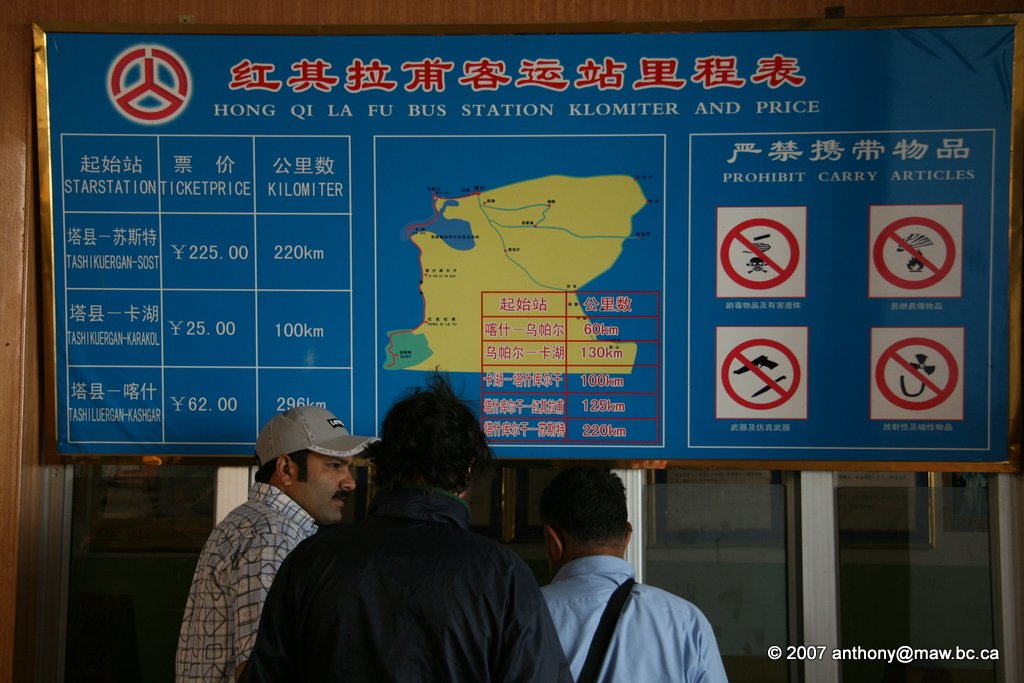
Tashkorgan is reached by the Karakoram Highway from Kashgar, about 290 kilometres and seven to nine hours of driving depending on the road and police checks. Long-distance buses leave Kashgar's south bus station daily in the morning, and shared taxis (typically four passengers) can be arranged from the same place; the shared taxis are faster and cost only marginally more. The road climbs steadily, with checkpoints at Ghez and Karakul Lake where foreign passports are recorded.

Foreigners need only a valid Chinese visa to reach Tashkorgan, but a separate Khunjerab Pass permit is required for the final stretch to the Pakistani border, and that section is in any case only open to those continuing through to Pakistan with vehicle and onward visa in order. Crossings happen daily during the season; international buses to Sost in Pakistan run when both governments allow it, which is not every year.

A small airport (Tashkurgan Khunjerab Airport) opened in 2023 with limited domestic flights from Kashgar and Urumqi, but the road remains the way most travellers arrive — and the road is half the point.

Guide

When to Go

The practical season is June through September. The Karakoram Highway is open year-round in theory, but landslides and snow regularly close sections from October through May, and even when the road is technically open, sub-zero overnight temperatures and limited services make winter travel an expedition. The Khunjerab Pass to Pakistan officially operates only from 1 April to 30 November.

July and August are warmest — daytime highs around 20°C, nights still cold enough for a sweater. June and September are quieter and clearer, with a higher chance of fresh snow on the surrounding peaks. Altitude sickness is real at 3,100 metres; pace the first day, drink water, and avoid alcohol on arrival.

The Tajik new year, Norooz, falls around 21 March and is a strong reason to visit if you can stand the cold — the cultural park hosts dances and feasts that are not really put on for tourists.