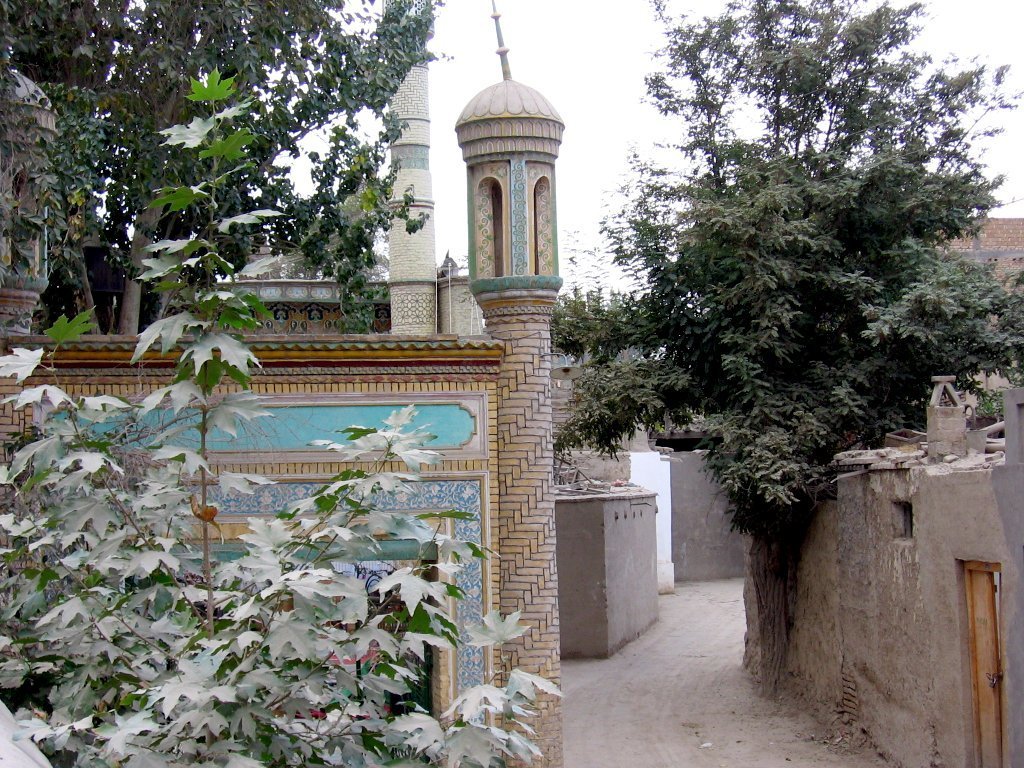
Yarkand — written Yarkant in Uyghur, Shache in Mandarin — sits on the southern Silk Road about 200 kilometres east of Kashgar, in a delta of rivers descending from the Karakoram. It is one of the oldest continuously inhabited cities in Xinjiang, a former capital of the Yarkand Khanate in the 16th and 17th centuries, when it was the wealthiest city between Samarkand and Beijing. Marco Polo passed through on his way to Cathay, noting the merchants and the jade. The jade trade still exists: the rivers here carry nephrite down from the Kunlun Mountains, and green stones are turned up in riverbeds after heavy rains.
The old city is the reason to come. Where Kashgar's old town has been extensively rebuilt and is now partly a theme park, Yarkand's has simply been left to age. The mud-brick lanes are narrower and darker, the workshops more dilapidated, the bazaar more local in character. The tomb complex of Amanisahan — a 16th-century Uyghur poetess and patroness of the classical muqam music tradition — anchors the old quarter, its green-tiled dome visible above the rooftops. Next to it, the Golden Graveyard holds the mausoleums of the Yarkand Khanate's royal family, a sequence of domed tombs that would command attention anywhere in the Islamic world. The Altyn Mosque, nearby, is the oldest mosque in the city.
Yarkand has been a centre of carpet weaving for centuries. The designs here differ from Kashgar's — more geometric, with deeper reds and more intricate borders — and the workshops that remain are genuinely traditional rather than tourist-facing. Prices reflect this: a good Yarkand carpet costs more here than in Kashgar but is more likely to be what it claims to be. The general bazaar, especially strong on dried fruit and Karakoram jade, runs on weekday mornings and fills the old town with noise and movement. The livestock market on the edge of town functions without the self-consciousness that has crept into Kashgar's equivalent.
Trains connect Yarkand to Kashgar in about two hours and to Hotan in three and a half. The town is increasingly served by the rail line that now runs along the entire southern edge of the Taklamakan, making it easier to string together the oasis towns of the southern route in a single journey rather than doubling back through Ürümqi.