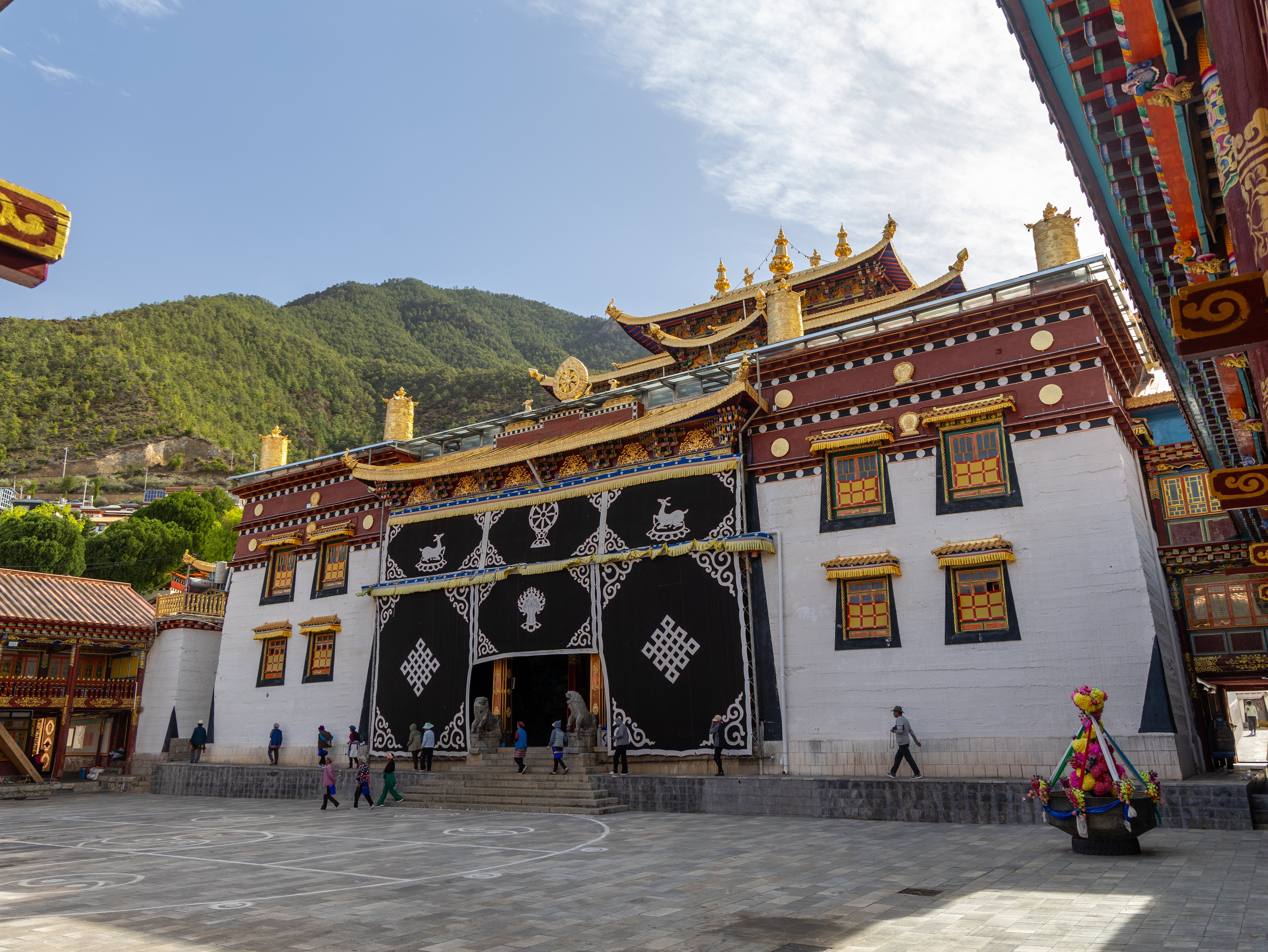
Deqin is a small Tibetan county town at 3,550 metres in the Hengduan Mountains of northwestern Yunnan, pressed between the Mekong River gorge and the eastern wall of the Himalayas. Around 80 percent of its 55,000 residents are Tibetan, and the town functions as the practical gateway to Meili Snow Mountain, a massif of eight peaks above 6,000 metres whose highest summit, Kawa Karpo at 6,740 metres, has never been climbed. A 1991 Japanese-Chinese expedition attempting the summit lost all 17 members to an avalanche; the mountain has been closed to climbing ever since, considered sacred by Tibetan Buddhists.
The principal pilgrimage for visitors is the sunrise view from Feilai Temple, a monastery perched on a ridge several kilometres before town on the road from Shangrila. In clear conditions — and they are far from guaranteed — the temple's courtyard frames the full sweep of Meili Snow Mountain as the first light turns the ice-capped peaks gold. It is a genuinely extraordinary spectacle when it happens, and travellers routinely wait two or three days for a cloudless morning. The town itself is, frankly, grim by Yunnan standards — modern concrete construction with little to redeem it — but as a base for hiking it earns its place.
From Deqin, trails push out in every direction through terrain that rewards the effort. The most celebrated destination is Yubeng village, an isolated Tibetan settlement accessible only on foot (or by mule), requiring a six-to-seven hour hike through alpine forest and over a high pass. Day hikes to the Mingyong Glacier, one of the lowest-altitude glaciers in the Northern Hemisphere, are straightforward in good weather, though the glacier has retreated dramatically in recent decades and the approach now involves a lengthy walk across old moraine. South of town, Dongzhulin Monastery and the Cizhong Catholic Church — an improbable Franco-Gothic building built by French missionaries in the nineteenth century — are worth the detour.
Altitude is a serious consideration. Deqin sits above 3,500 metres and the surrounding trails climb considerably higher. Travellers coming directly from low elevations should spend at least a night acclimatising before attempting anything strenuous, and the narrow winding road up from Shangrila — spectacular but genuinely vertiginous — is best treated as a day in itself rather than a prelude to immediate exertion.