Mandalay is the second largest city in Myanmar, a sprawling, flat, low-rise place that surprises many visitors by feeling less like a city than a very large town. There is no skyline. The Irrawaddy lies to the west and the hazy Shan Hills rise to the east. What Mandalay has, in extraordinary abundance, is Buddhist heritage and the crafts that came with royal patronage.
The city was founded in 1857 by King Mindon, who moved his capital here from Amarapura in fulfilment — or so he arranged the numbers to show — of a prophecy attributed to the Buddha himself. Mandalay Fort and its vast moat anchor the centre of town, though the original teak palace buildings burned in 1945 and what stands today is a reconstruction. Mandalay Hill rises immediately to the north, crowned with shrines and offering the best views over the city. At its foot, Kuthodaw Pagoda houses 729 marble tablets inscribing the complete Buddhist canon — the World's Largest Book. Nearby, Shwenandaw Monastery is the last surviving building from Mindon's original palace, its teak carved with extraordinary intricacy.
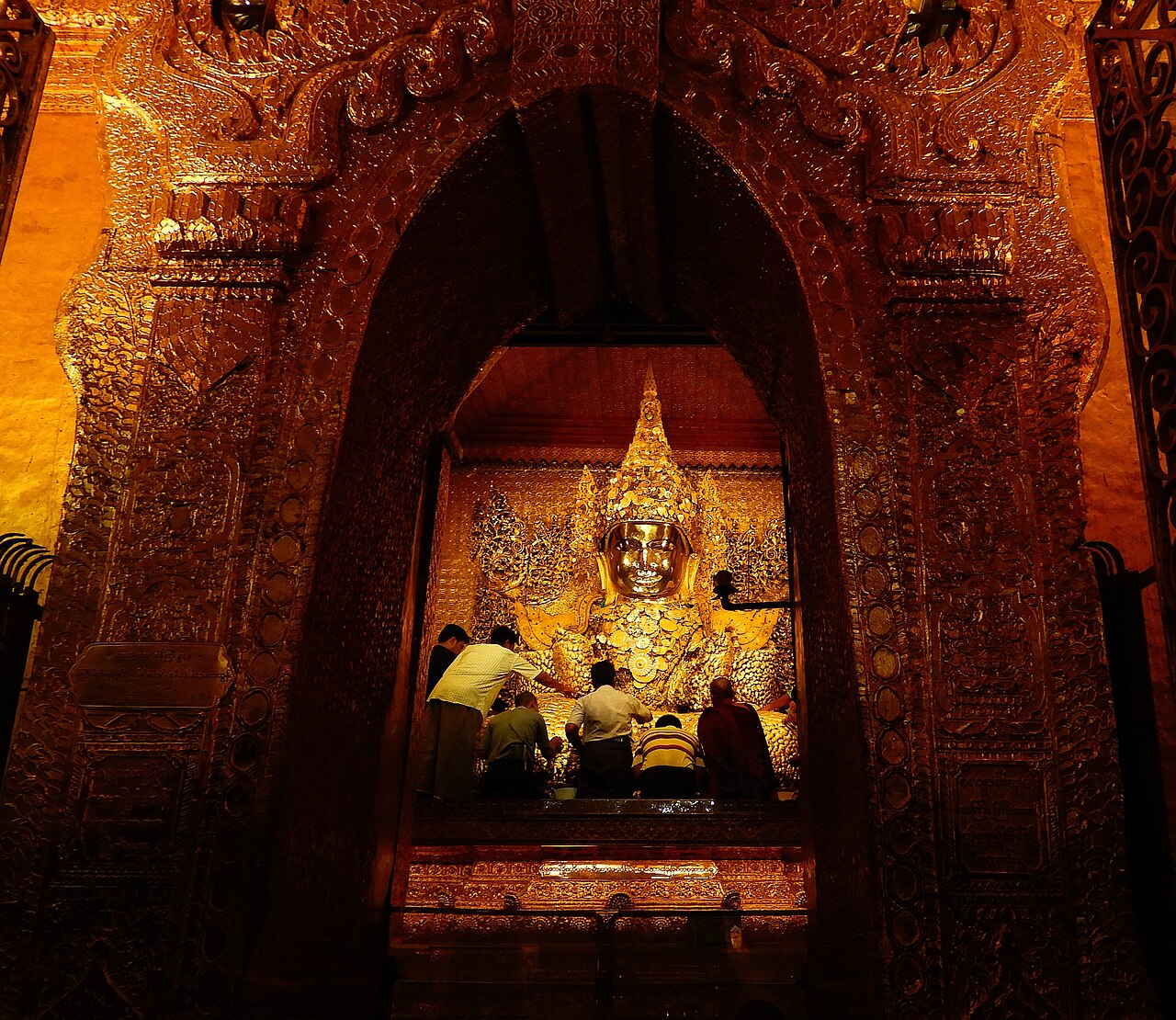
The most sacred site in the city is the Mahamuni Buddha Temple southwest of the palace, where male worshippers have applied gold leaf to the image for so many centuries that the metal is now several centimetres thick. The best excursions from the city take you to U Bein Bridge at Amarapura, the extraordinary 1.2-km teak footbridge at sunset, and across the Irrawaddy to Sagaing Hill with its hundreds of monasteries in the forested slopes. A boat ride upstream leads to Mingun and its unfinished giant stupa.
Mandalay is Myanmar's craft capital — silk weaving, goldbeating, marble carving, lacquerware, and bronze casting are all practised here. The Jade Market gives a window into one of the country's most important commodities. The city is also the main departure point for Bagan, Inle Lake, and the north of the country.