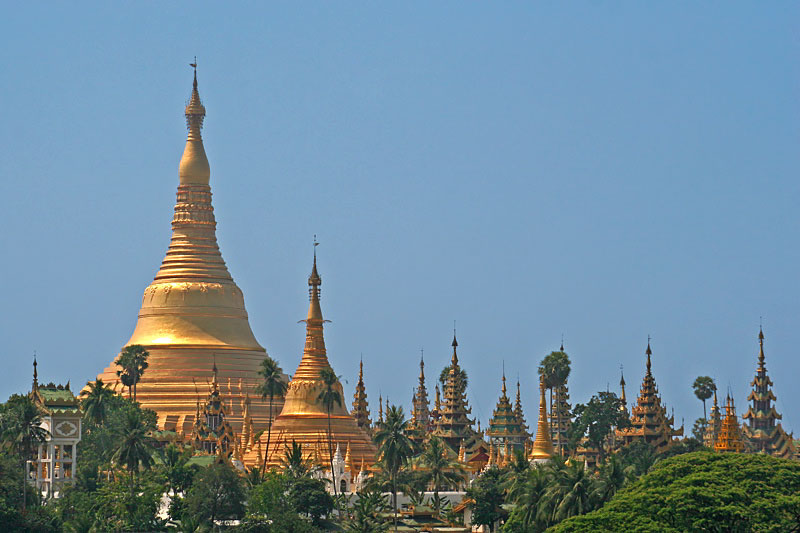
Yangon is Myanmar's largest city and commercial capital, a sprawling place of lakes, pagodas, and crumbling colonial buildings set against a backdrop of street vendors and trishaws. It is not as frantic as Bangkok or as clean as Singapore, but it has a character all its own — slow-moving and atmospheric in a way that most of Southeast Asia no longer is.
The Shwedagon Pagoda dominates the skyline and is the undisputed centrepiece of any visit. The glistening gold-covered stupa, reputedly 2,500 years old, towers over Singuttara Hill and draws pilgrims from across Myanmar. Allow a few hours here, particularly at dusk when the light is at its best. The Chaukhtatgyi Buddha Temple north of the Shwedagon houses one of the largest reclining Buddhas in the country.
Downtown Yangon preserves one of Asia's most intact grids of British colonial architecture. The grand but decaying buildings along Strand Road and the streets surrounding Bogyoke Market were built in the early 20th century and remain largely unchanged. The Secretariat — where independence leader Aung San was assassinated in 1947 — is now partly open to visitors. The Strand Hotel, though expensive, is worth visiting for a drink at the bar.
The Sule Pagoda sits at the centre of a downtown roundabout, a gilded stupa surrounded by colonial government buildings. At the riverfront end of downtown, the Botahtaung Pagoda is uniquely hollow — visitors can walk through its mirrored interior. For an unhurried cross-section of city life, the Circular Railway loops around the outer suburbs for three hours, cheap and revealing.