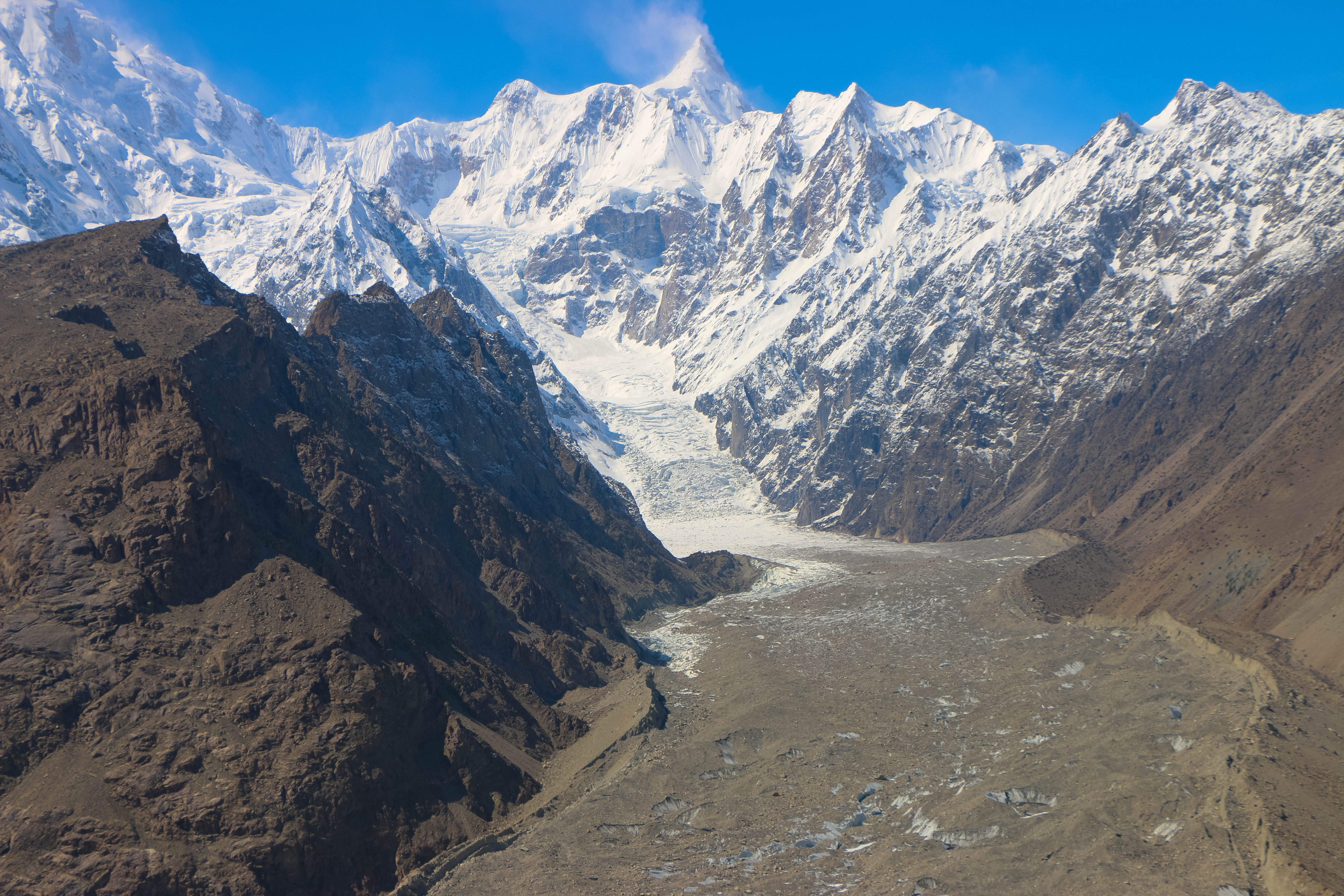
Ghulkin is a village in Gojal, upper Hunza, reached by following the Karakoram Highway (KKH) 140 km north of Gilgit — a journey of three to four hours by van. From a turn-off just beyond Gulmit, a winding jeep track climbs 3 km until the ground flattens out and the first houses come into view. The main draws are the Ghulkin Glacier, walkable in an hour, and Borith Lake, a bird-rich saline lake two kilometres north.
The village occupies the silted bed of an ancient glacier-fed lake, and the layout still reflects that origin: around 140 traditional stone dwellings are arranged in a rough circle, their facades oriented toward what were once the lake's shores. The central area — formerly open water — now holds fields and a strip of land frequently pressed into service as a cricket pitch. The circular arrangement gives the village an unusually communal feel.
The name comes from the Wakhi words ghulk (well) and kin (whose). No written records survive of the village's founding, though local tradition places it around 600 years ago and suggests that settlements existed here while the lake was still present, used as summer pastureland.
The community is Ismaili Muslim, and the Jammatkhana — the central religious institution of the Ismaili world — is the heart of village life. Beyond its role as a place of worship, it serves as a meeting hall, a venue for festivals and celebrations, and a forum for resolving disputes.
Winters in upper Hunza are long and genuinely cold, with temperatures dropping well below freezing at night. Snow brings the Himalayan ibex down from the heights in search of exposed grass — a striking sight for anyone willing to travel here in the colder months. Summers are warm, reaching around 30°C, and far more comfortable than the plains below.