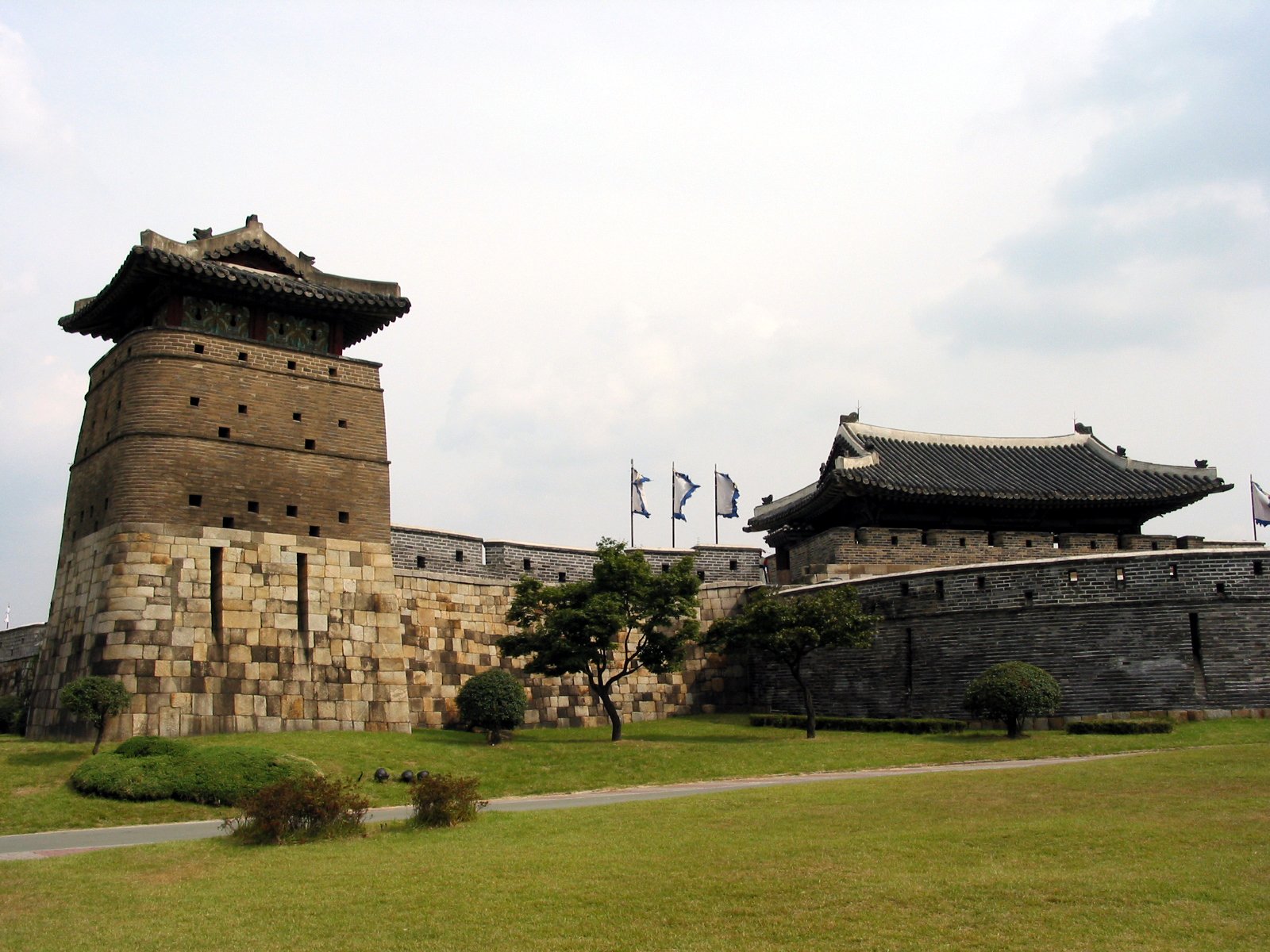
Suwon is the capital of Gyeonggi Province and South Korea's largest provincial city, home to about 1.2 million people thirty kilometres south of Seoul. It is almost always described in terms of Hwaseong Fortress, the UNESCO-listed 18th-century walls that loop nearly six kilometres around the old city centre, and that remains the most compelling reason to come here. The fortress is genuinely impressive in scale and state of preservation — the sort of monument that rewards a slow walk rather than a quick look.
King Jeongjo ordered the construction of Hwaseong Fortress in 1794 to relocate the capital here and to honour the memory of his father, Crown Prince Sado, who was executed by his own grandfather — the then king — after being locked in a rice chest in 1762. The fortress was built in two years using 700,000 workers and incorporating the most advanced military engineering of the period, including water gates, observation towers, and a sophisticated command structure. Despite the ambitious plan, Jeongjo died before the relocation could occur, and Suwon remained a provincial city. The fortress walls and gates were heavily damaged during the Korean War but reconstructed using an extraordinarily detailed illustrated construction manual, the Hwaseong Seongyeok Uigwe, compiled during the original build.
Within the fortress walls, the old centre has a lively market street and several points of interest including the Haenggung palace complex — a detached palace used by the royal family during visits to Suwon — and the Hwaseong Haenggung, the largest of the five Joseon detached palaces. The surrounding modern city is a significant industrial and technology hub: Samsung Electronics is headquartered here, and the semiconductor facilities outside the city are among the most productive in the world.
For visitors from Seoul, Suwon is a half-day excursion at most — the fortress circuit takes two hours, the Haenggung complex another hour, and the journey from Seoul Station by commuter train takes forty minutes. The interesting oddity of Mr Toilet House, a toilet-shaped museum dedicated to global sanitation, is a signature Suwon eccentricity worth noting.