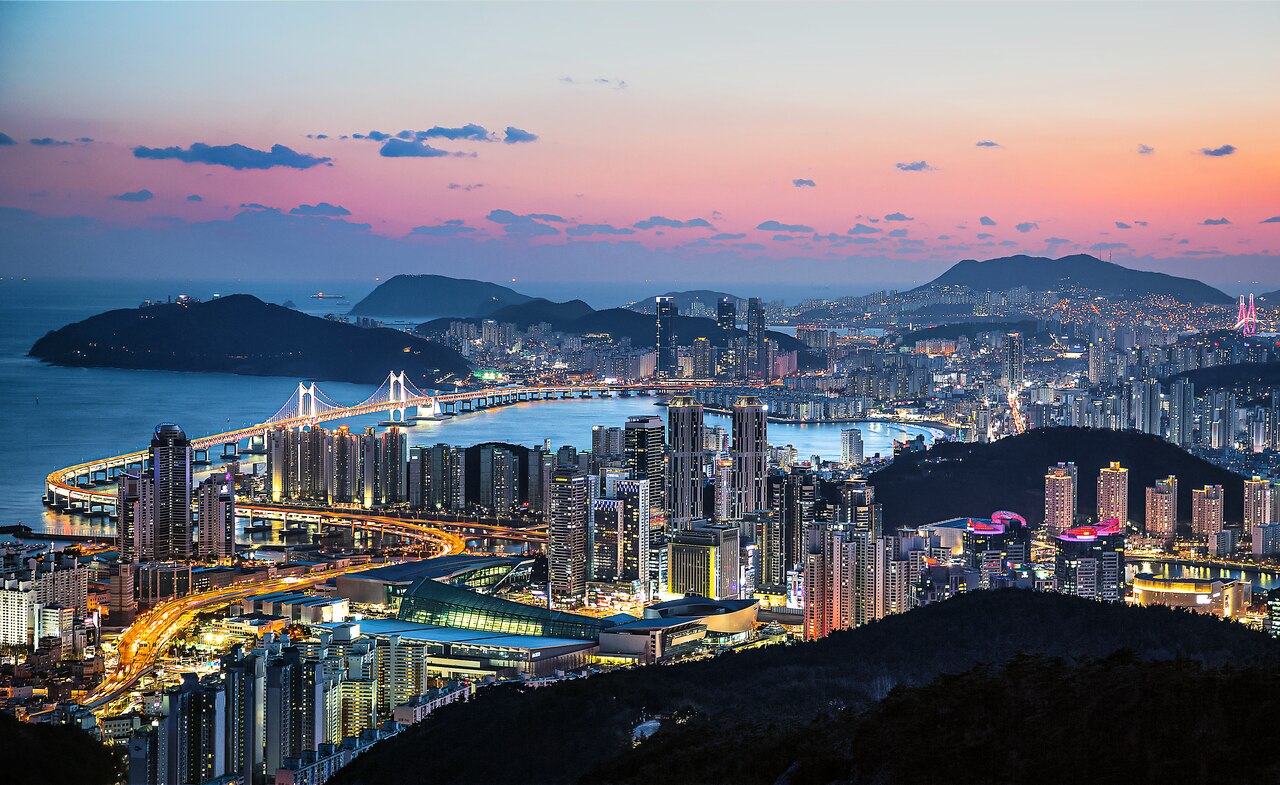
Busan is South Korea's second city — a sprawling port of nearly four million people wedged between steep hills and the sea. It's louder, saltier, and more working-class than Seoul: container ships crowd the horizon, the fish market starts before dawn, and the mountains drop so abruptly into the coastline that entire neighbourhoods cling to the cliffs.
The beaches are the main draw. Haeundae is Korea's most visited, and for good reason — wide, white sand backed by a busy promenade, buzzing on summer nights and surprisingly peaceful at dawn. Gwangalli is the locals' favourite: smaller, with a dramatic view of Gwangan Bridge lit up after dark.
Inland, Gamcheon Culture Village climbs a hillside in a riot of painted staircases and murals — built by wartime refugees and now an open-air gallery of murals and installations. Beomeosa Temple sits in the mountains north of the city, quiet and forested, a sharp contrast to the energy below. On the far northeast coast, Haedong Yonggungsa Temple clings to the cliffs above the sea — one of the few Buddhist temples in Korea built directly on the water. The UN Memorial Cemetery honours the soldiers of sixteen nations who died in the Korean War; Busan was the last city never taken by the North.
Jagalchi Fish Market is worth an early-morning visit to watch the auction floor in action. Street food is excellent throughout the city — look for dwaeji gukbap (pork and rice soup), the Busan signature. In October, the Busan International Film Festival brings Asia's biggest film event to the Haeundae and Centum City districts.
Busan is 340 km southeast of Seoul and a natural jumping-off point for Jeju Island.