Far out in the north-west of Western Australia lies Broome — 2,046 km north of Perth, on the edge of the Kimberley. Once genuinely isolated, it has been discovered as a destination for good reason: Cable Beach is one of the finest stretches of sand in Australia, the light in the dry season is extraordinary, and the town has a multicultural history unlike anywhere else in the country. The best time to visit is between April and September, when the heat is manageable and the sea swimmable.
Broome once thrived on its pearling industry. Eighty per cent of the world's mother-of-pearl came from Broome's 400 pearling luggers at the industry's peak, with crews drawn from Japan, China, the Philippines, Malaysia, and Aboriginal Australia. After the introduction of the plastic button in the 1950s the industry collapsed, but the multicultural legacy it left is still visible in the town's Chinatown, the Broome Japanese Cemetery, and at the Pearl Luggers museum, where restored boats and former divers tell the story. The Broome Historical Society Museum on Saville Street covers the wider history, including the Japanese attack on the town in 1942.
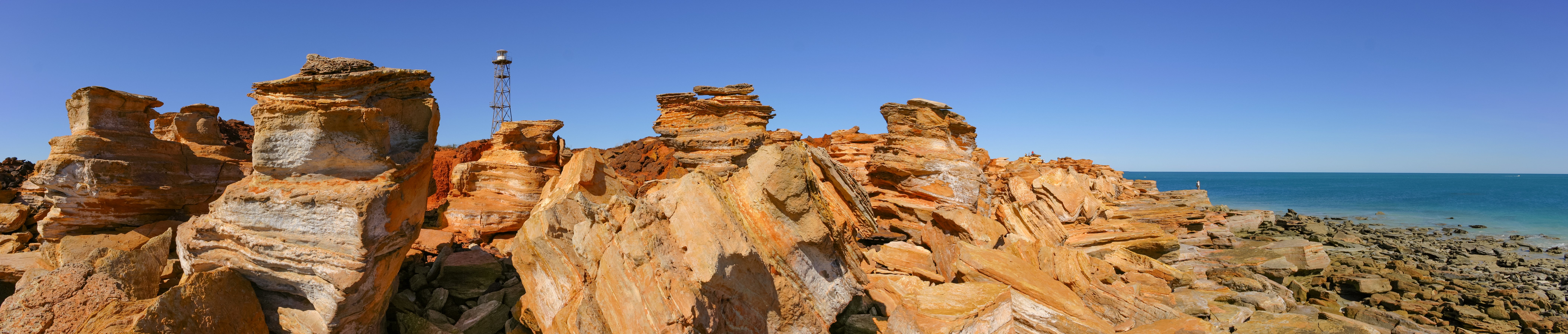
The Staircase to the Moon is one of those natural phenomena that actually lives up to the hype: on full-moon nights during the dry season, the moon's reflection in the Roebuck Bay mudflats creates a shimmering golden staircase effect. It happens on perhaps three or four nights per month — check the exact dates with the visitor centre. Out on the southern edge of town, Gantheaume Point offers dinosaur footprints, dramatic red cliffs, and excellent sunset light.
Sun Picture Gardens on Carnarvon Street is the world's oldest continuously operating outdoor cinema — open since 1916, still showing current films under the stars. Between May and November, Broome hosts several festivals, the largest being the week-long Shinju Matsuri (Festival of the Pearl) in August, which celebrates the town's multicultural heritage with parades and traditional ceremonies.