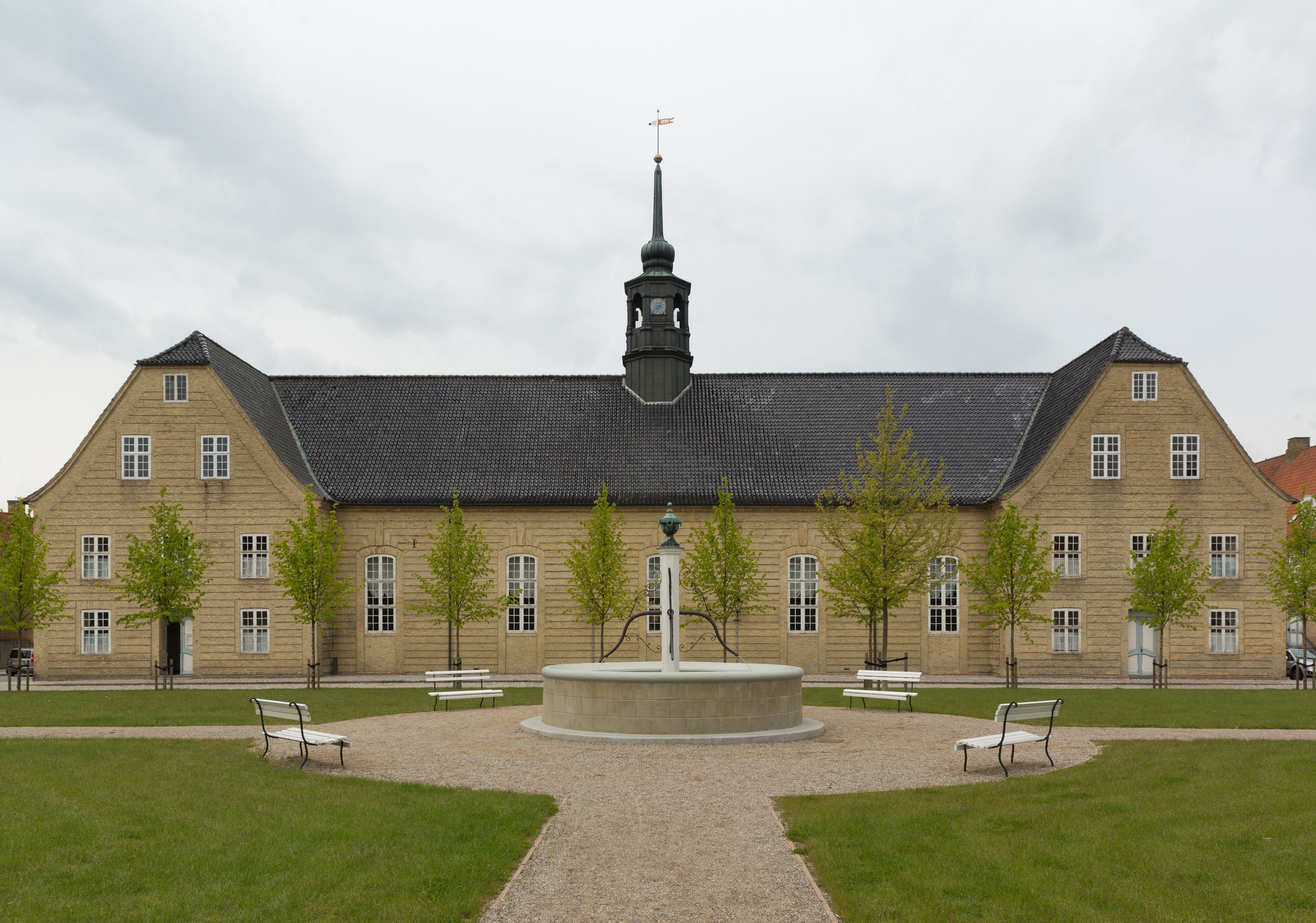
Christiansfeld is a planned town founded in 1773 by the Moravian Brethren — the Herrnhuter Brüdergemeine — a Protestant community with roots in Bohemia that spread across Europe in the 18th century. The settlement was listed as a UNESCO World Heritage Site in 2015, one of seven Moravian settlements worldwide to receive the designation.
The town was built around principles of equality and communal life, and its layout reflects that. The buildings are uniform: yellow Flemish-bond brick in two and three storeys, arranged in straight streets around a central square (Brødremenighedspladsen). There are no grand houses and no hovels. The community hall, the church, the sisters' house, and the brothers' house all occupy the same architectural register. Everything is still remarkably intact — Christiansfeld never grew or modernised in ways that would have disrupted the grid.
The God's Acre (Guds Ager) cemetery lies just outside the centre, flat and open, with identical white headstones laid in rows. Men and women are buried in separate sections; a bishop's stone looks exactly like a cobbler's. The effect is striking and unlike any other Danish churchyard.
The Moravian Brethren are still present in Christiansfeld — a small congregation maintains the church and the traditions, including the production of honningkager, the distinctive honey cakes that have been made here since the 18th century. They are sold at the bakery on the main square and nowhere else quite like them exists in Denmark.
Christiansfeld is about 20 kilometres south of Kolding and easily combined with a visit to Haderslev nearby.