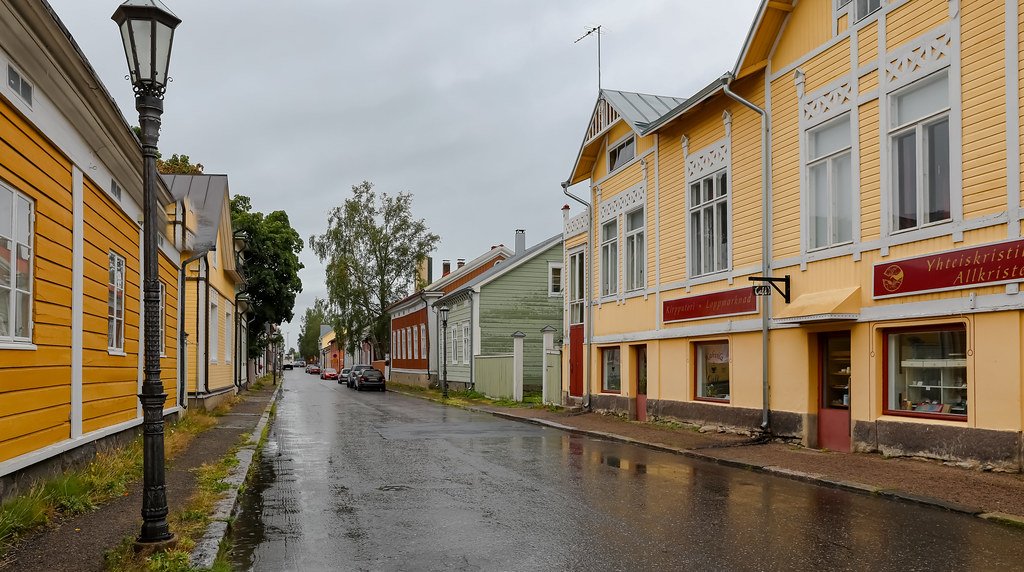
Kokkola is one of those small Finnish coastal cities that most travellers blow past on the train between Vaasa and Oulu. That is a mistake. This bilingual city on the Gulf of Bothnia has a beautifully preserved wooden old town, a surprisingly lively cultural scene, and the kind of quiet charm that rewards anyone willing to slow down.
The heart of Kokkola is Neristan, a neighbourhood of colourful wooden houses dating back to the 18th and 19th centuries. Walking its narrow streets feels like stepping into a painting — pastel facades, cobblestones, small gardens behind picket fences. It is one of the best-preserved wooden town centres in Finland, and unlike similar districts elsewhere, people still live here. The English Park in the same quarter contains a British longboat captured during the Crimean War — one of Finland's more unexpected historical curiosities.
The city sits at the edge of the Bothnian Bay, and the surrounding archipelago is striking. Tankar, a lighthouse island about an hour by boat, has been a landmark for sailors since the 1500s and makes for a memorable day out in summer. Closer to town, the beaches at Ohtakari offer shallow, warm water by Finnish standards.
Kokkola punches above its weight culturally. The annual Kokkola Opera in July and the Kokkola Winter Accordion Festival draw visitors from across Finland. The town has a strong musical tradition — the Snellman Hall concert venue and the Kokkola Concert Hall both host regular performances.
For a city of around 48,000 people, Kokkola has a distinctive dual identity. About 15% of the population speaks Swedish as their first language, and the city's official Swedish name is Karleby. You will see bilingual signs everywhere, and both languages shape the local culture. It is a practical, unpretentious place — a good base for exploring the Ostrobothnia coast.