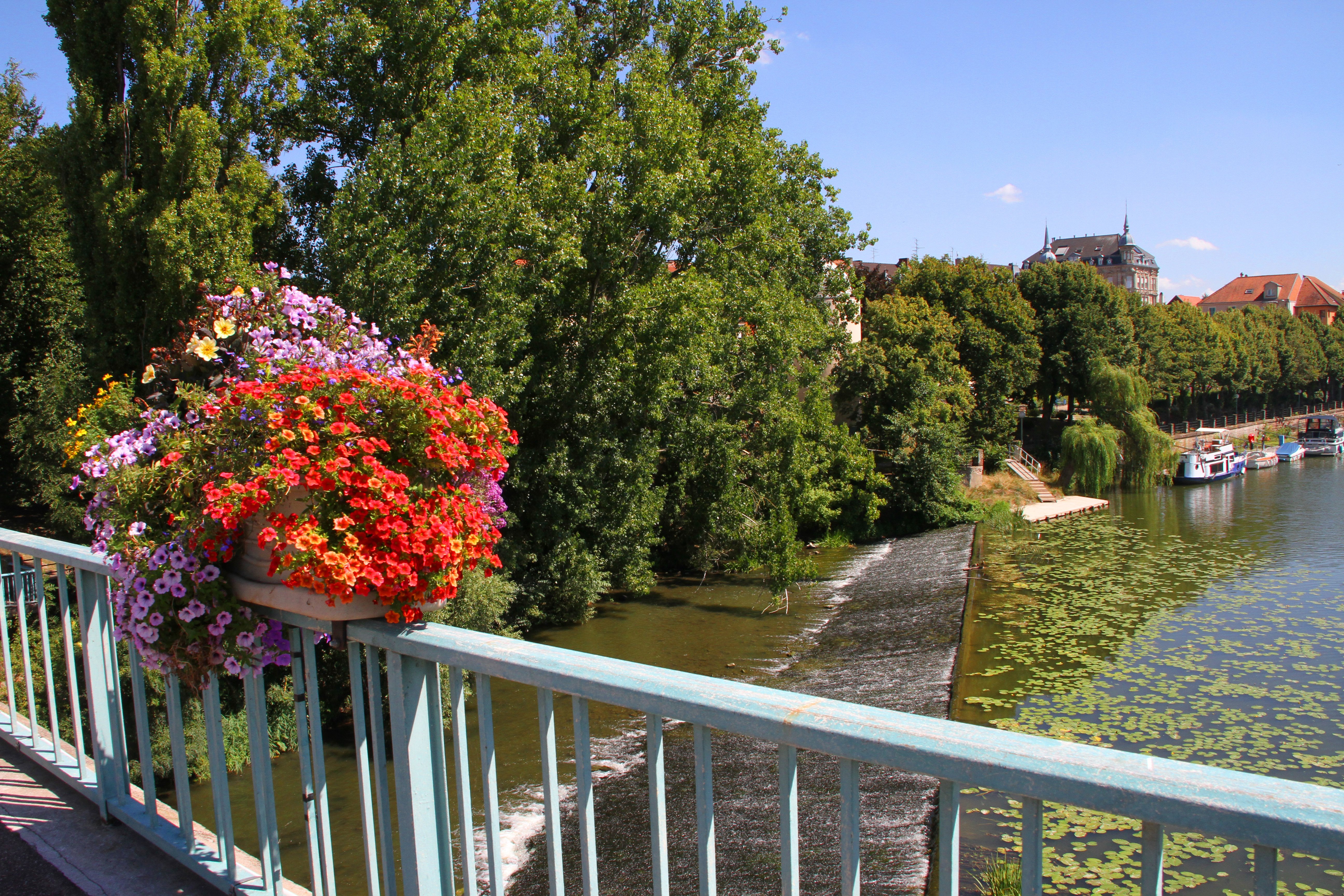
French-German border town at two rivers, historically known for its faience ceramics industry.
Sarreguemines sits where the Sarre and Blies rivers meet, right on the French-German border — the German town of Kleinblittersdorf is a short walk across the bridge. With around 21,000 residents, it's a quietly confident provincial town that knows what it is: the home of one of France's most famous ceramics traditions.
The faience works here date to 1790, when Nicholas-Henri Jacobi founded a manufactory that eventually became one of Europe's largest producers of decorative earthenware. At its peak in the late 19th century the factory employed thousands and shipped its distinctive majolica tiles and tableware across the continent. The factory closed decades ago but the legacy is everywhere — in the tile-covered buildings, in the outstanding ceramics museum housed in the old director's villa, and in the antique shops that stock original pieces.
The town centre is pleasant rather than spectacular: a pedestrian street, a decent market square, a Gothic church. The riverside paths along the Sarre are genuinely nice for a walk. If you have a few hours between Metz and Saarbrücken, or you're interested in industrial history and decorative arts, Sarreguemines rewards a stop.
Guide
Eating Out
Sarreguemines sits right at the intersection of French and German culinary traditions, which makes for an interesting menu. The French side dominates — this is Moselle, after all — but you will find sauerkraut and knuckle of pork as readily as coq au vin. The local speciality is quiche Lorraine in its most authentic form: a rich custard in a butter pastry with no added vegetables, exactly as it was made before the dish became an international cliché.
The pedestrian centre has several brasseries that do a reliable plat du jour at lunch. For dinner, the better restaurants cluster around the market square and the riverside. Crossing the bridge to eat in Kleinblittersdorf on the German side is easy and offers a change of pace, with German portions and prices.
Guide
Getting There
Sarreguemines has direct train connections to Metz (about 75 minutes) and Saarbrücken in Germany (about 20 minutes), making it easy to combine with either city. The station is a short walk from the town centre and the main tourist sights. Trains from Strasbourg require a change at Haguenau and take around 90 minutes.
By car, Sarreguemines sits on the A4 motorway between Metz and Strasbourg, with a direct junction. From Paris, the drive is about four hours. The German city of Saarbrücken is 20 kilometres to the north and has the nearest major airport, served by Ryanair and Lufthansa among others.