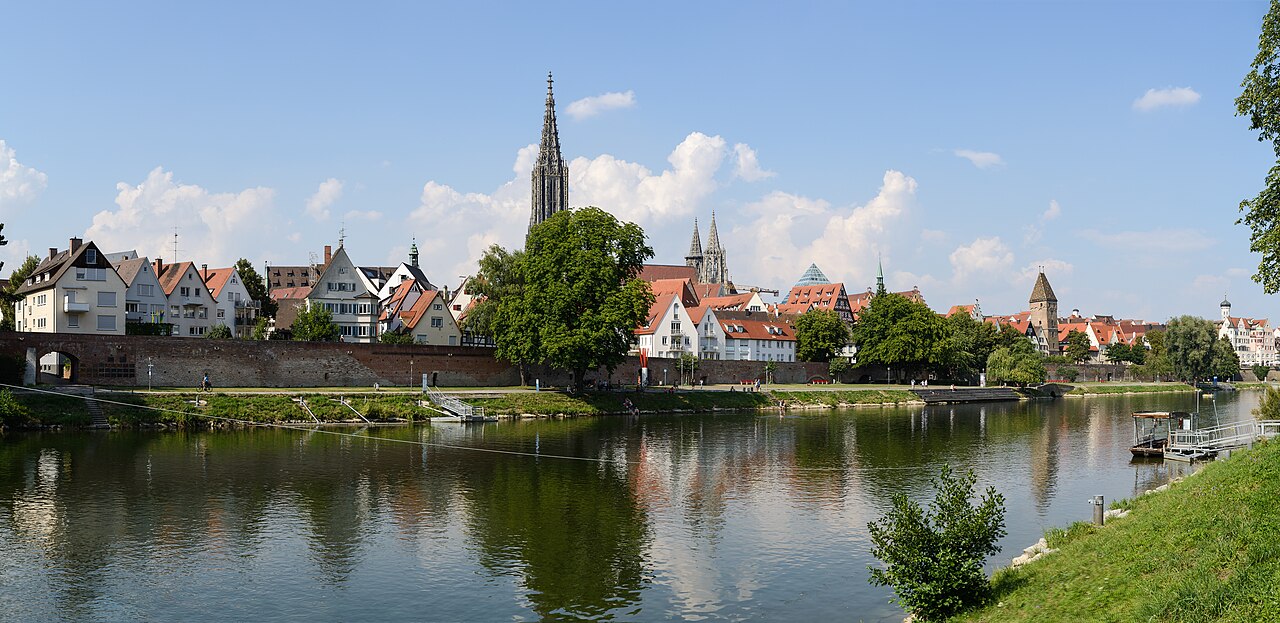
Ulm sits on the Danube in Baden-Württemberg, right where southern Germany feels most itself. The city is best known for its Minster, whose spire at 161.5 metres is the tallest church tower in the world. Climb the 768 steps for a view that stretches to the Alps on a clear day.
The old town along the Danube is Ulm at its most charming. The Fischerviertel (Fishermen's Quarter) is a tangle of half-timbered houses, narrow lanes, and small canals fed by the River Blau. The Crooked House, a medieval house leaning precariously over the water, claims to be the most crooked hotel in the world. The Ulm Museum on the Marktplatz holds the Lion Man — a 40,000-year-old figurine from the Swabian Alb that is the oldest known figurative work of art in the world.
Ulm is also Einstein's birthplace, a fact the city celebrates with an eccentric Einstein Fountain near the site of his family home. The Stadthaus, a striking white building by Richard Meier on the Münsterplatz, makes for an arresting contrast with the Gothic cathedral next door.
The city was heavily bombed in 1944, and you can still read the history in its architecture: medieval survivors stand next to postwar rebuilds and occasional bursts of bold modern design. A ring of 19th-century fortifications surrounds the city, with about 40 structures still standing. The most sobering is Fort Oberer Kuhberg, used as a concentration camp under the Nazis and now a memorial and documentation centre.
Across the Danube lies Neu-Ulm, technically in Bavaria. The two cities share a riverfront promenade that is perfect for an evening walk.