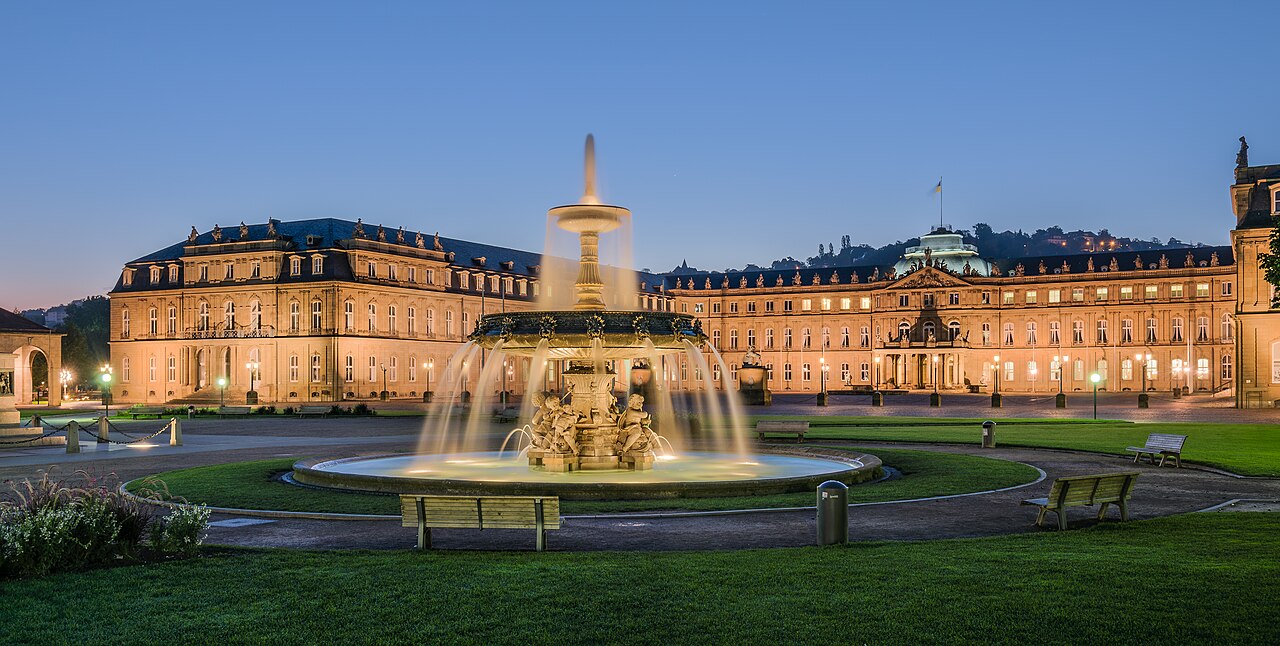
Stuttgart is set in a bowl in the Swabian Hills — a city of vineyards, forested ridges, and steep valleys that give it a completely different topography from the flat industrial cities of the Rhine plain. It is the capital of Baden-Württemberg, the home of Mercedes-Benz and Porsche, and a city whose charms are genuine but take some finding.
The center pivots around Schlossplatz, the large square flanked by the New Palace and the Kunstmuseum Stuttgart in its glowing glass cube. The Staatsgalerie, with works by Rembrandt, Picasso, and Joseph Beuys in a postmodern extension by James Stirling, is one of Germany's finest art museums. Schillerplatz next to the Old Palace and the Stiftskirche is Stuttgart's oldest square and the best starting point for walking the historic center.
For automotive history, the Mercedes-Benz Museum in Untertürkheim is a spectacular double-helix building holding 130 years of automobile history, while the Porsche Museum in Zuffenhausen traces the sports car maker's history from the 356 onward. The Stuttgart TV Tower south of the city, completed in 1956 as the world's first concrete television tower, gives panoramic views over the Neckar valley and the Swabian Alps. The Weissenhof Estate on a northern hillside is a UNESCO-listed housing exhibition from 1927 with buildings by Mies van der Rohe, Le Corbusier, and 15 other modernist masters.
Stuttgart sits on remarkable thermal springs. The Mineral Bath Berg is the oldest and quietest of the city's mineral baths. The Wilhelma zoo and botanical garden, set in a 19th-century Moorish palace complex in Bad Cannstatt, is one of Germany's most unusual attractions. The city also grows wine on urban hillsides — some vineyards are within walking distance of the center, and the local Trollinger and Lemberger wines are drunk almost entirely by locals. Stuttgart is about 100 miles south of Frankfurt.