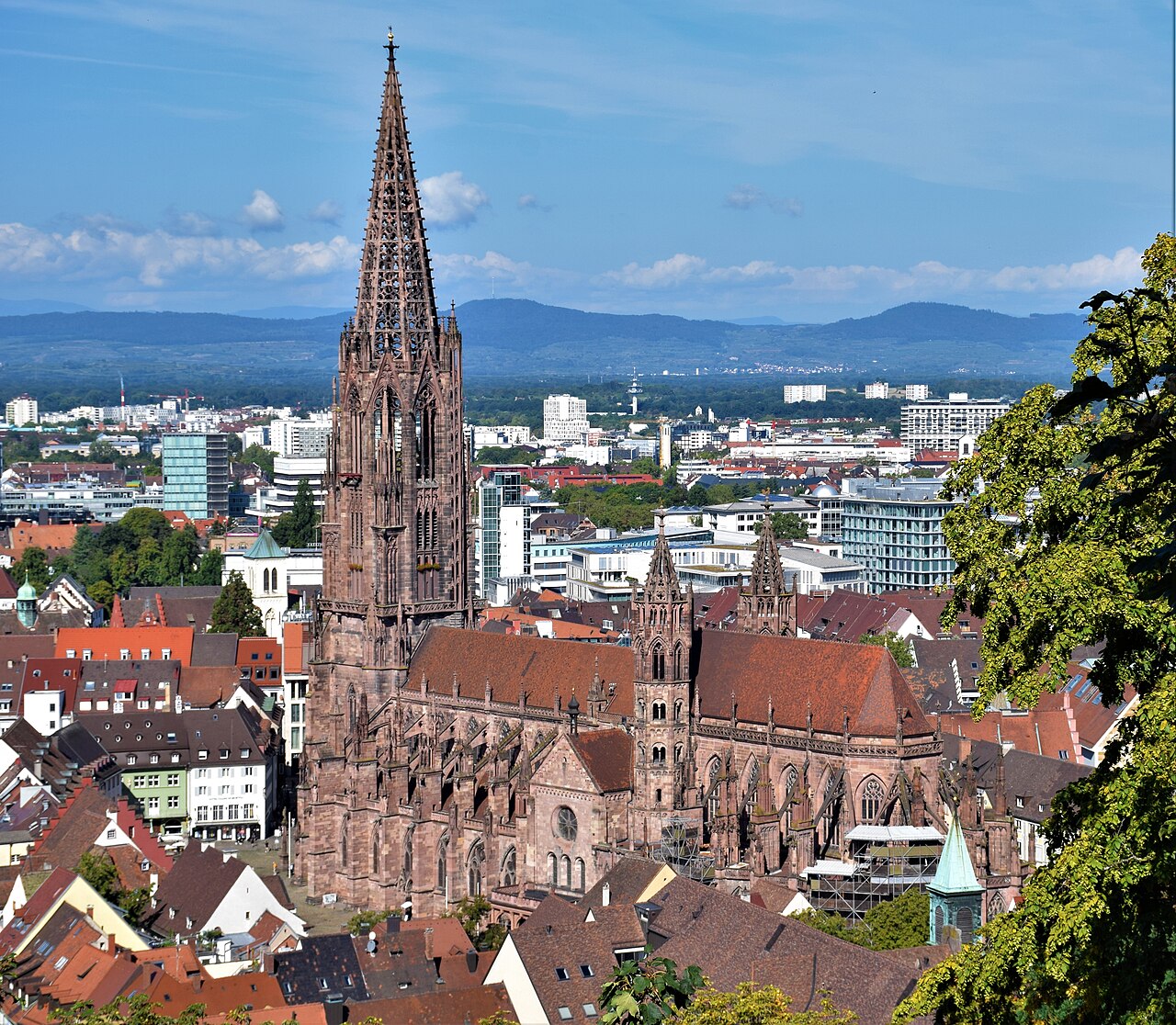
Freiburg im Breisgau is the sunny southwestern corner of Germany, tucked against the western edge of the Black Forest within sight of France and Switzerland. It is the warmest city in the country, with a Mediterranean feel to its summers, and one of its most pleasant — a compact, walkable old town built around a single great Gothic cathedral, with 200,000 people, 25,000 students, and very few cars.
The medieval heart fits within fifteen minutes' walk. At its centre is the Münsterplatz, with its daily produce market sheltering under the spire of the Münster, and the blood-red trading hall of the Historisches Kaufhaus on the south side. The two surviving medieval gates — the Martinstor and the Schwabentor — mark the edge of the old town, and the University, founded in 1457, spills its buildings through the western quarter. Running along the edge of nearly every street are the Bächle, the narrow medieval water channels that have become the city's emblem.
Freiburg is also Germany's greenest city in the literal sense. The wooded Schlossberg rises straight up behind the old town to a viewpoint over the rooftops, and a cable car climbs from the southern suburbs up the Schauinsland — the Black Forest summit that overlooks the city. Beyond, the wine villages of the Kaiserstuhl produce some of Germany's best Pinot Noir, and Strasbourg, Basel, and the deep Black Forest are all an easy day out.
The student population gives the city its lively pulse. The bars along Gerberau, the steps of the Augustinerplatz in summer, the Fastnacht carnival in February, and the wine festival on the Münsterplatz in June all feel younger and looser than the average German city.
Freiburg im Breisgau is not to be confused with the Swiss French-speaking Fribourg, its namesake further south.