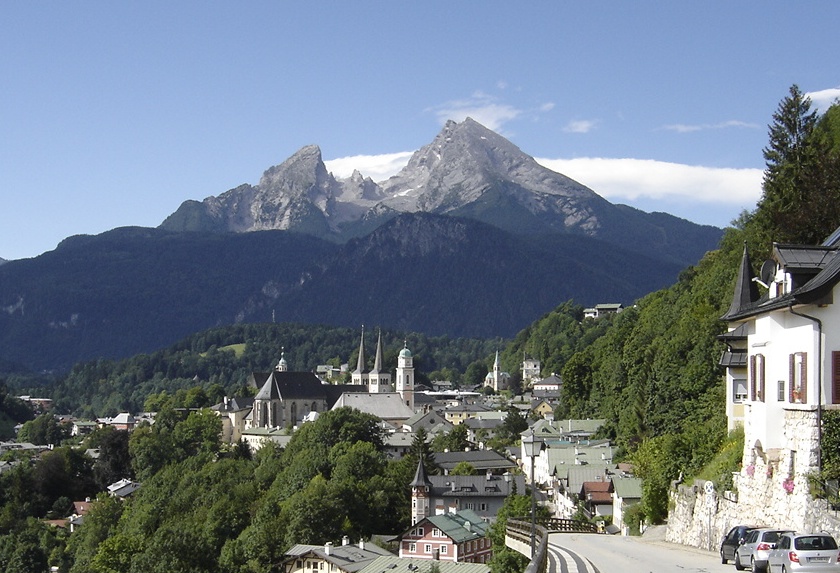
Berchtesgaden is a market town of about 8,000 people in the far south-eastern corner of Bavaria, 150 km south-east of Munich and surrounded by the snow-capped peaks of the Berchtesgaden Alps. It sits in one of the most dramatically beautiful valleys in Germany — a cul-de-sac of the Alps almost entirely surrounded by Austrian territory, and protected since 1978 as Berchtesgaden National Park, the only Alpine national park in Germany. The landscape is what brings almost everyone here: the jade-green waters of Königssee, the 1,874-metre Watzmann (Germany's third-highest peak, a colossal double-summited mountain that dominates the valley), and the cable-car-accessed Jenner and Kehlstein viewpoints.
The single most-visited sight is Königssee, a deep, narrow alpine lake ringed by sheer cliffs, reached by electric boat from the village of Schönau at its northern end. The silent electric-only boats (motorised transport has been banned on the lake since 1909) take you to the famous red-onion-domed St Bartholomä church on a small peninsula halfway down the lake, and further on to the quiet Obersee beyond. The boat captains traditionally stop halfway and play a flugelhorn, whose echo bounces back off the cliffs — it is a cliché, and it is still wonderful. Above the town, the salt mines (Salzbergwerk) of Berchtesgaden, working since the 16th century, are open for tours on little underground trains. The Haus der Berge is an excellent free museum on the park's ecology.
For many visitors, Berchtesgaden is also inseparable from its more uncomfortable history. The mountain above the town, Obersalzberg, was where Adolf Hitler had his mountain retreat, the Berghof, and where much of the senior Nazi leadership built holiday homes during the 1930s and 1940s. The Berghof itself was destroyed by bombing in 1945 and then completely demolished by the Bavarian government in 1952 to prevent it becoming a shrine, but the mountaintop Kehlsteinhaus ("Eagle's Nest"), a stone pavilion built for Hitler's 50th birthday in 1939, survives and is now a restaurant — reached by a dramatic road carved into the mountain and a brass-panelled elevator inside the rock. The excellent Dokumentation Obersalzberg museum, opened in 1999, is an unflinching and detailed account of the history of the Nazi era here. Most visitors combine the two faces of Berchtesgaden: a morning at Königssee, an afternoon at the documentation centre, and a return to Munich in the evening.