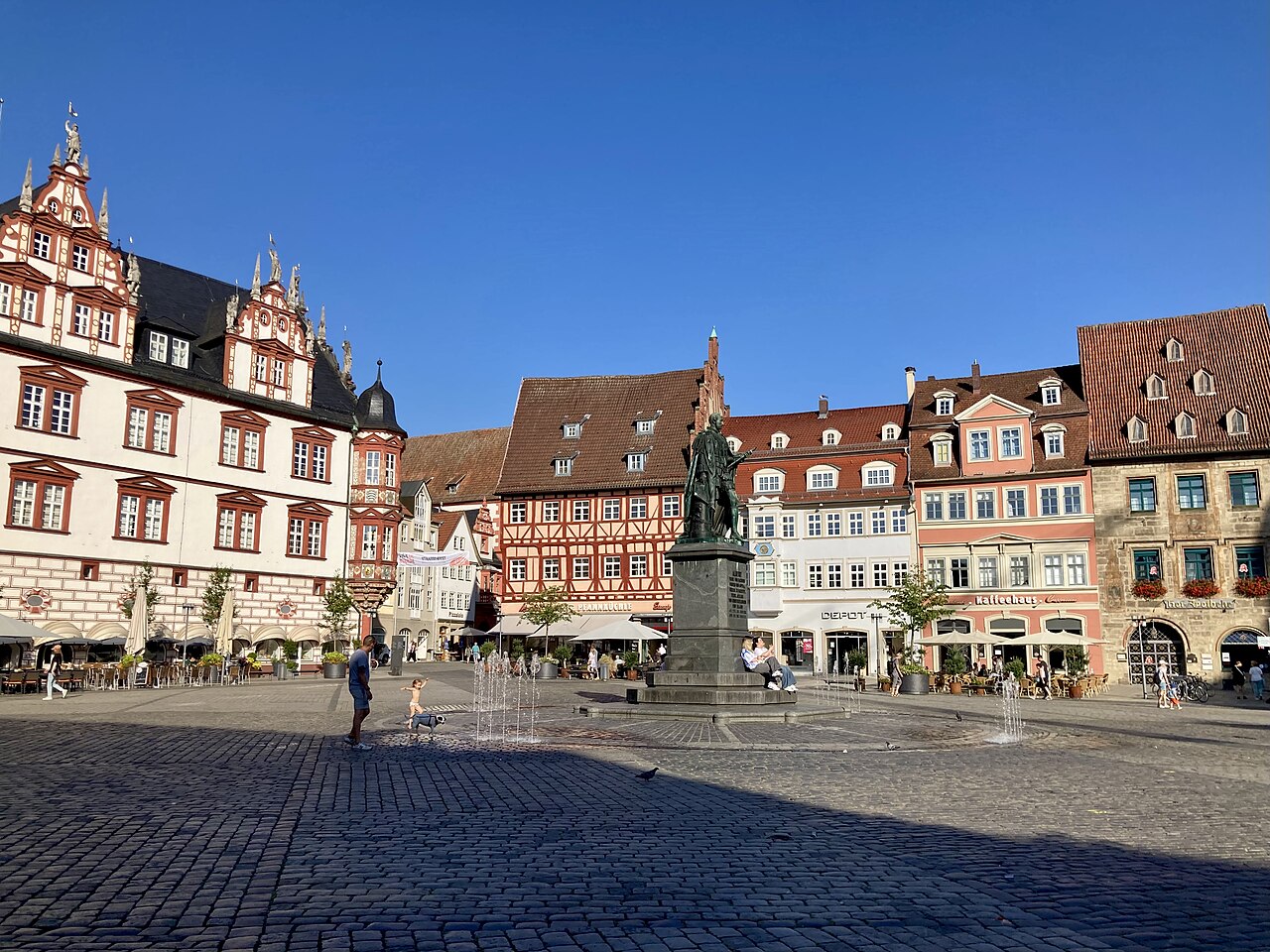
Coburg sits at the northern edge of Bavaria, close to the Thuringian border — a quietly impressive town that most visitors to Germany skip entirely. That's their loss. The Veste Coburg, the massive hilltop fortress looming over the town, is one of the best-preserved medieval castles in Germany and houses a significant art collection including works by Cranach and Dürer. Down in the town centre, Schloss Ehrenburg served as the ducal palace of the House of Saxe-Coburg, whose descendants ended up on the thrones of Britain, Belgium, Portugal, and Bulgaria — Coburg's royal connections are genuinely surprising for a town this size.
The town's history is layered with moments of outsized importance. In 1530, Martin Luther took refuge here for six months in the Veste while the Diet of Augsburg debated the Reformation below; he spent the time translating the Old Testament into German. Three centuries later, Prince Albert — born nearby at Schloss Rosenau — carried the Saxe-Coburg name to the British throne through his marriage to Queen Victoria, and the palace in town still shows the English furniture and portraits that Victoria brought on her visits. The Stadtkirche St. Moriz near the Marktplatz holds Luther's connection too, as does the square named for him near the Lutherplatz.
Coburg is also famous throughout Franconia for its bratwurst — longer than the Nuremberg variety, grilled over pinecone embers, and served in a crusty roll. The bratwurst stands on the market square are not a tourist contrivance; this is simply where the town eats. The Landestheater Coburg is an improbably good professional opera and theatre company for a city of 40,000 people, and the Kunstsammlungen Coburg spread across the Veste and Ehrenburg hold collections that would be headline attractions in a larger city.
Coburg was on the inner-German border until 1990, and the sense of a town that sat at the edge of things — geographically, politically — is still faintly present. It's a rewarding stop between Bamberg, 40 kilometres to the south, and Thuringia to the north.