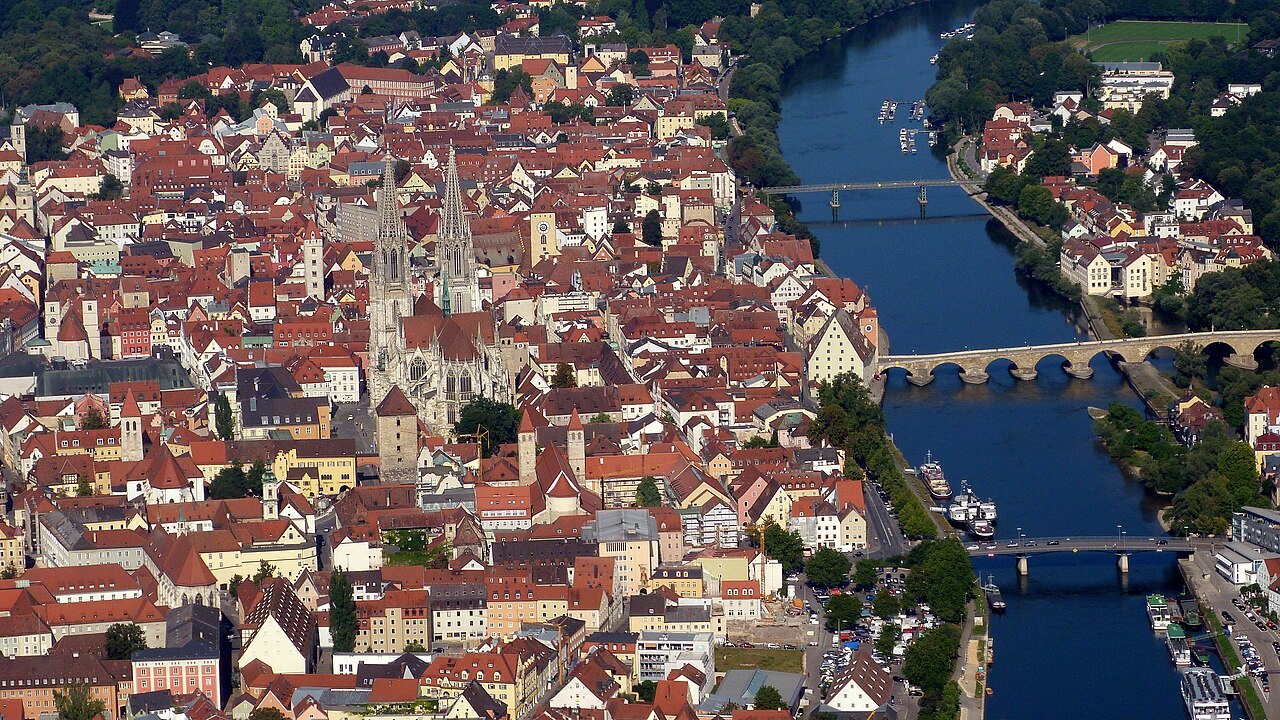
Regensburg is one of Germany's best-preserved medieval cities, a UNESCO World Heritage Site on the Danube in eastern Bavaria. For over 600 years — from 1245 until Napoleon arrived in 1803 — it was a free imperial city and a prosperous trading centre. Unlike most German cities, it came through the Second World War largely unscathed, leaving an extraordinary concentration of medieval and early-modern architecture intact.
The Steinerne Brücke (Stone Bridge), built in 1135–1146, is Germany's oldest surviving stone bridge and gives the finest view of the city's skyline — a forest of towers rising above the Danube. At the foot of the bridge, the Historische Wurstkuchl has been grilling sausages on the same riverside spot since the construction workers arrived in 1135. The Regensburg Cathedral (Dom St Peter) is the most important Gothic building in Bavaria, with stunning 14th-century stained glass and the Domspatzen boys' choir founded around 975 AD.
The old town is a tangle of narrow lanes, patrician tower-houses (Regensburg has more medieval towers than any German city), and lively squares. Saint Emmeram's Abbey — now partly a Thurn und Taxis family palace — preserves extraordinary Carolingian cloisters and a crypt full of saints' relics. The Scots Monastery has a Romanesque portal from the 1180s that is among the finest carved stonework in Germany. The Old Town Hall was where the Perpetual Imperial Diet met from 1663 to 1806 — the first standing parliament in European history.
Regensburg is also a university city with a young population, good restaurants, and a beer garden culture that rivals Munich's — at a fraction of the tourist crowds.