Fulda is one of those German cities that functions as a kind of geographical and historical fulcrum. Located in eastern Hesse roughly equidistant from Frankfurt, Kassel, and Erfurt, it was founded around the Benedictine monastery established by Saint Boniface in 744, and Boniface — the English-born monk who more than any other individual is responsible for the Christianisation of Germany — is buried here. His tomb beneath the cathedral draws Catholic pilgrims from across the German-speaking world.
The Dom, built in the early eighteenth century in a Roman Baroque style strongly influenced by Borromini's Sant'Agnese in Rome, dominates the city centre with a confident grandeur that still surprises first-time visitors. The crypt contains the saint's tomb and original stone sarcophagus; the treasury holds relics, vestments, and an extraordinary collection of early medieval goldsmith's work. Immediately beside the Dom stands the Michaelskirche, a Carolingian round church from the ninth century that is among the oldest surviving ecclesiastical buildings in Germany. The contrast between the two buildings — one swaggering Baroque, one austere Carolingian — tells a good deal of the story of Christian architecture in one glance.
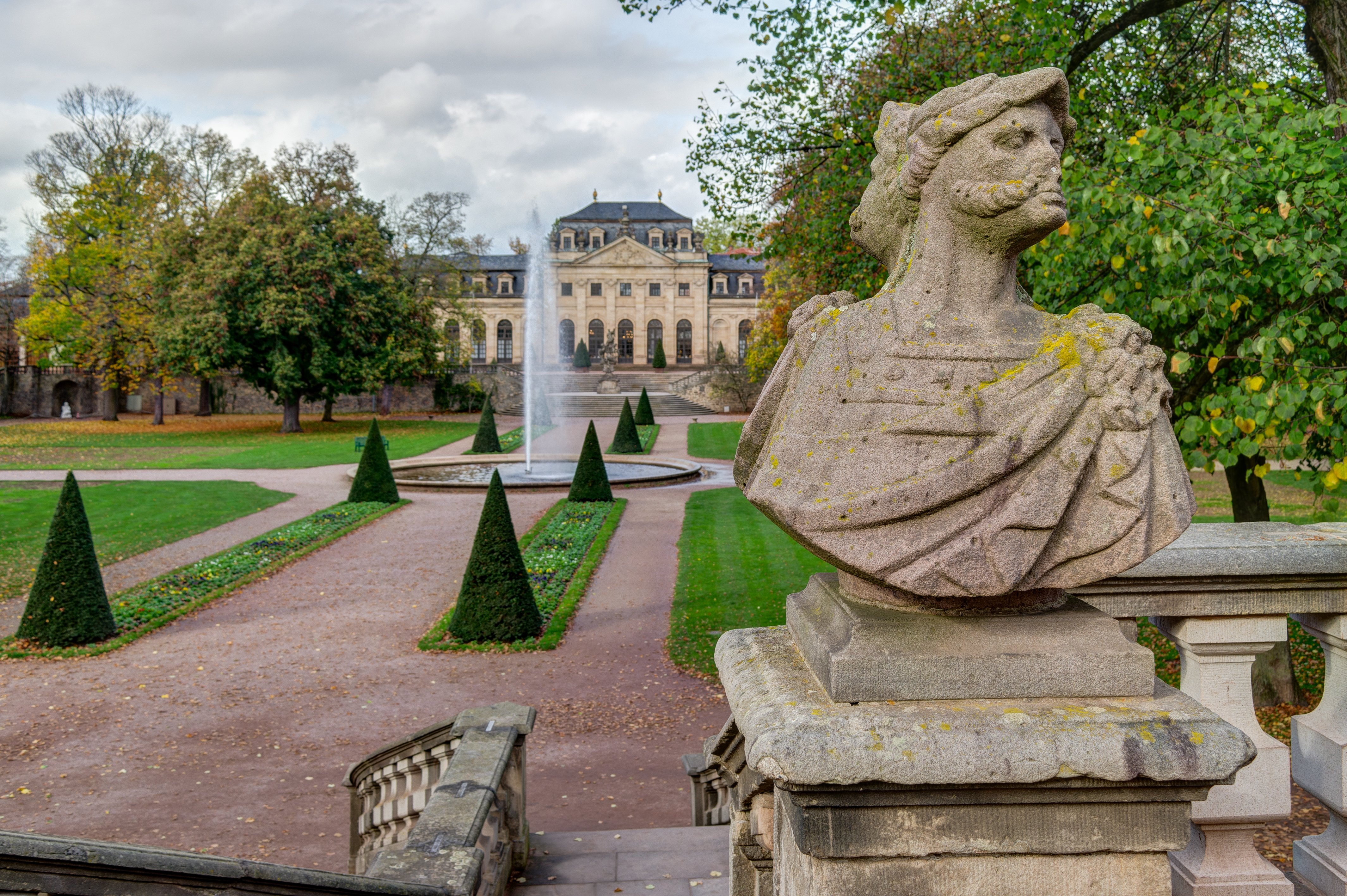
The Prince-Abbots' Palace to the north of the cathedral precinct is a restrained Baroque composition by Johann Dientzenhofer around a formal garden. The adjacent Orangery and the geometric flower gardens in front give the city its characteristic southern German ceremonial formality, transplanted unexpectedly into the Hessian landscape. Fulda is a compact city and the historic centre can be walked thoroughly in half a day, which makes it a good stop en route rather than requiring a dedicated visit. The Rhön mountains and biosphere reserve begin almost immediately outside the city, providing walking country of distinctive volcanic character.