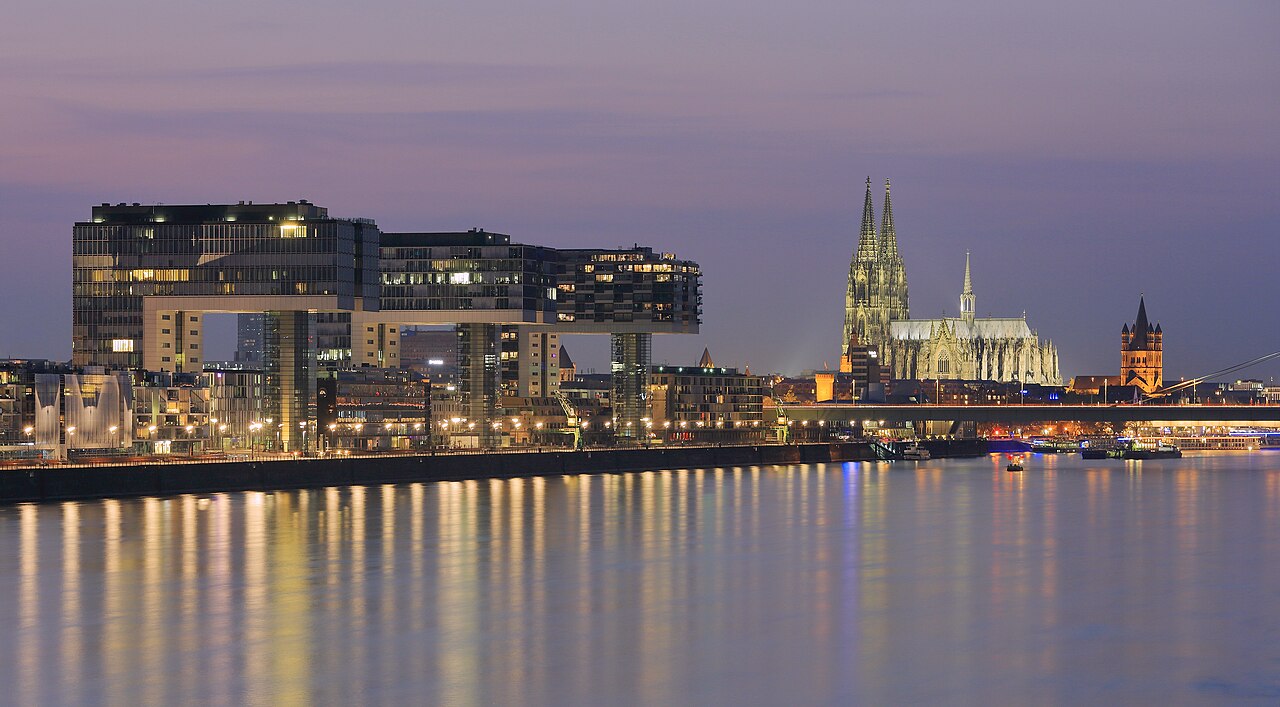
Cologne is one of Germany’s oldest cities, founded as a Roman colony in 50 AD, and it has been important ever since. The Cologne Cathedral dominates the skyline with its twin Gothic spires — at 157 metres it is still the tallest in the world — and the museum cluster between the Dom and the Rhine contains some of the finest collections in the country. But Cologne is not a museum city: it is a living, noisy, convivial place where the Kölsch beer flows freely and the annual Carnival turns the streets into one of the great street parties of Europe.
The city was heavily bombed in World War II — the 1942 "1000 bomber raid" destroyed much of the old town — but the cathedral survived (narrowly), the Great St. Martin Church was rebuilt, and the Altstadt was reconstructed with enough fidelity to feel genuinely old. The Romano-Germanic Museum tells the story of the Roman city; the Wallraf-Richartz-Museum has medieval German painting and Impressionism; Museum Ludwig covers 20th-century art. The Kolumba art museum, in a building by Peter Zumthor, is one of the most beautiful museum spaces in Europe.
On the gastronomic front, Cologne has more bars per capita than anywhere else in Germany. The drink is Kölsch — a light, top-fermented beer served in small cylindrical glasses by roving waiters who replace empties without being asked. The oldest and most celebrated of the brewery houses is Früh am Dom, just across from the cathedral. The Chocolate Museum on the Rhine and the Farina Fragrance Museum — birthplace of Eau de Cologne — are among the more unusual attractions. The Hohenzollernbrücke, the railway bridge beside the cathedral, is worth crossing for the view and for its famous weight of love locks.