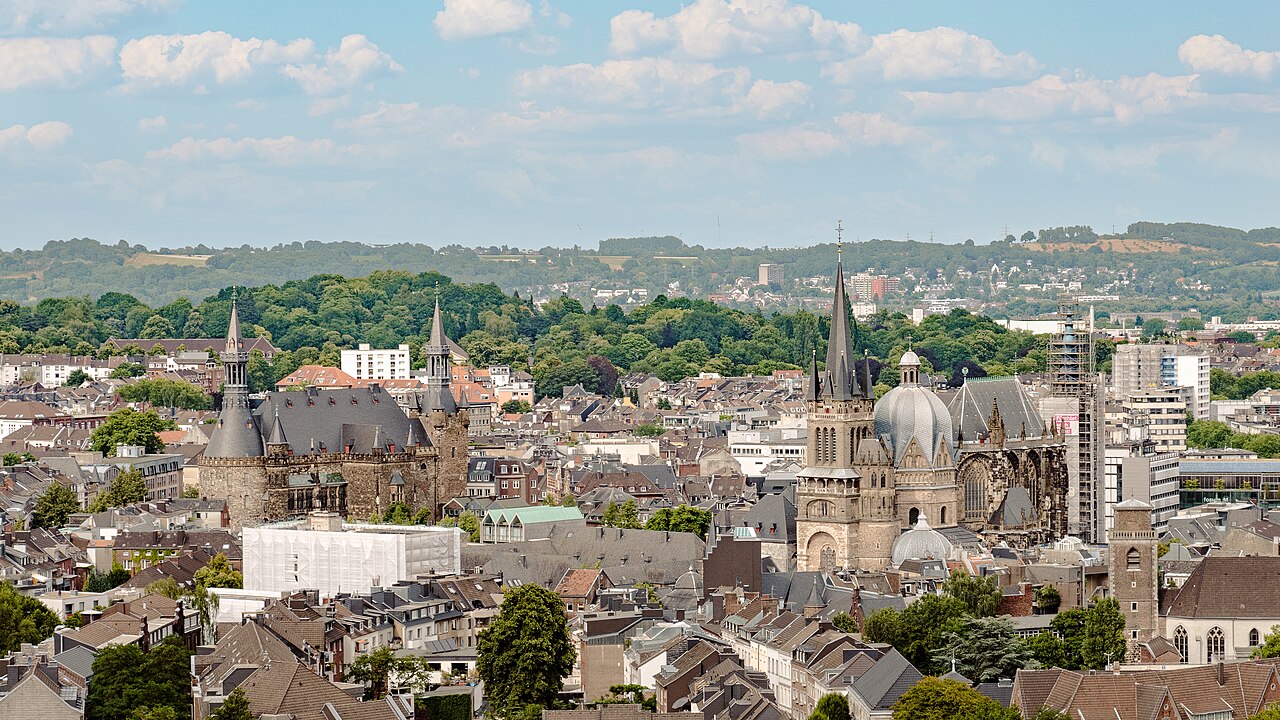
Aachen is a small city in the northwest corner of Germany, touching the borders of Belgium and the Netherlands at the same time. For centuries its identity was defined by two things: the hot springs that rise through the rock below the old town, and Charlemagne, who built his palace here in the 790s and turned a thermal resort into the capital of an empire that stretched from the Pyrenees to the Elbe.
The Aachener Dom is the city’s undisputed centrepiece — a UNESCO World Heritage site and one of the great medieval buildings of Europe, where thirty Holy Roman Emperors were crowned between 936 and 1531. The Cathedral Treasury next door holds Charlemagne’s relics and some of the finest medieval goldwork in the world. The Rathaus, built on the foundations of the Carolingian palace, faces the Dom across Am Markt and gives the old town its second great medieval building.
Beyond the historic core, Aachen is a university city — RWTH Aachen is one of Germany’s top technical universities, and 45,000 students give the place an energy that older German cities sometimes lack. The Pontstrasse runs north from the old town through the student quarter and has the best concentration of bars and cheap restaurants. The Carolus Thermen lets you bathe in the same sulphurous springs that Charlemagne used.
The Three Countries Triangle is 8 km to the west — the hilltop point where Germany, Belgium, and the Netherlands meet — and a popular excursion. Cologne is 60 km east and reachable in 45 minutes by fast train.