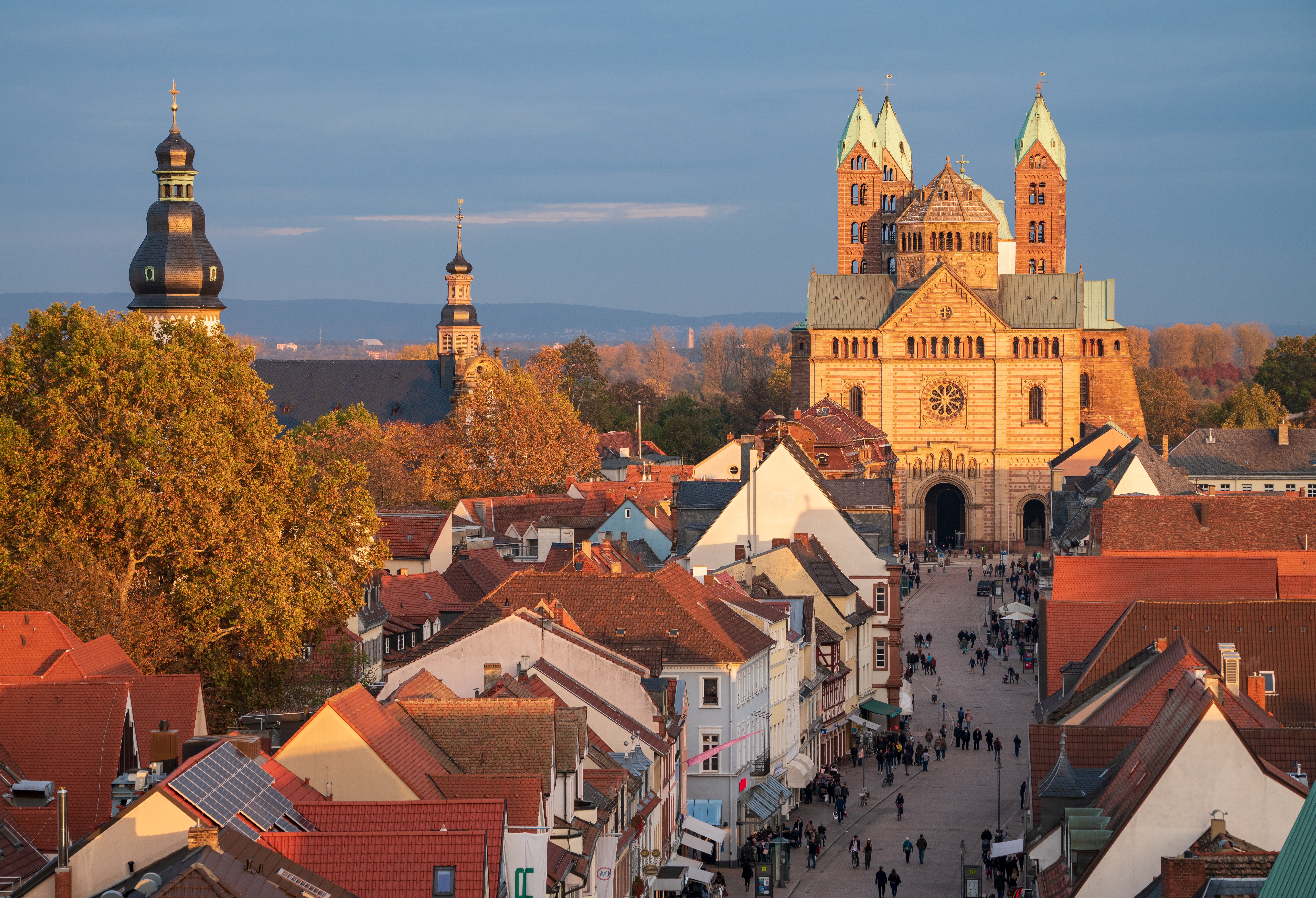
Speyer is a small Rhine city with an outsized historical legacy. As a free city of the Holy Roman Empire from 1294 until 1779, it hosted over 50 imperial diets and was the seat of the Imperial Chamber Court. The Protestant Reformation itself takes its name from the "Protestation at Speyer" of 1529.
The city is best known for its cathedral — the Kaiserdom, or Dom St. Maria und St. Stephan — by most accounts the finest surviving Romanesque church in the world. Built in the eleventh century under the Salian emperors, it remained the largest church in Christendom for many years. The reddish sandstone exterior is best seen from the east end, where the symmetry of the apses and towers is striking. The interior is vast and cool, with painted vaulting and a crypt where four Holy Roman Emperors are buried.
Beyond the cathedral, Speyer is a pleasant, walkable city. The Altpörtel, a preserved medieval city gate, stands at the western end of the main street. The Dreifaltigkeitskirche, a Baroque church from 1701–17, adds to the old town's appeal. The city's Jewish heritage — it was one of the original cities of the ShUM alliance alongside Worms and Mainz — is recalled at the Judenhof, where a medieval mikveh (ritual bath) has been preserved underground. The ShUM heritage sites were designated a UNESCO World Heritage Site in 2021.
The Historisches Museum der Pfalz covers the region from prehistoric times, with a highlight being a gold Neolithic cone hat — one of only four ever discovered. The Technik Museum on the edge of town is a crowd-pleaser, with a Boeing 747, a Soviet space shuttle and a submarine among its exhibits.