Worms is a small city on the left bank of the Rhine in the Rhineland-Palatinate, roughly halfway between Mannheim and Mainz. The unfortunate English name aside — it has nothing to do with worms, and is pronounced "Vorms" in German — this is one of the oldest continuously inhabited cities in Germany, and one of the most historically weighty for its size. It was a Celtic settlement, then a Roman garrison town called Borbetomagus, then the Burgundian capital before being destroyed by the Huns in the 5th century (the event that forms the backdrop of the Nibelungenlied, the German medieval epic). It was later a Holy Roman imperial city, the site of more than a hundred imperial diets, and — most famously — the place where Martin Luther refused to recant his Reformation writings before Emperor Charles V in 1521.
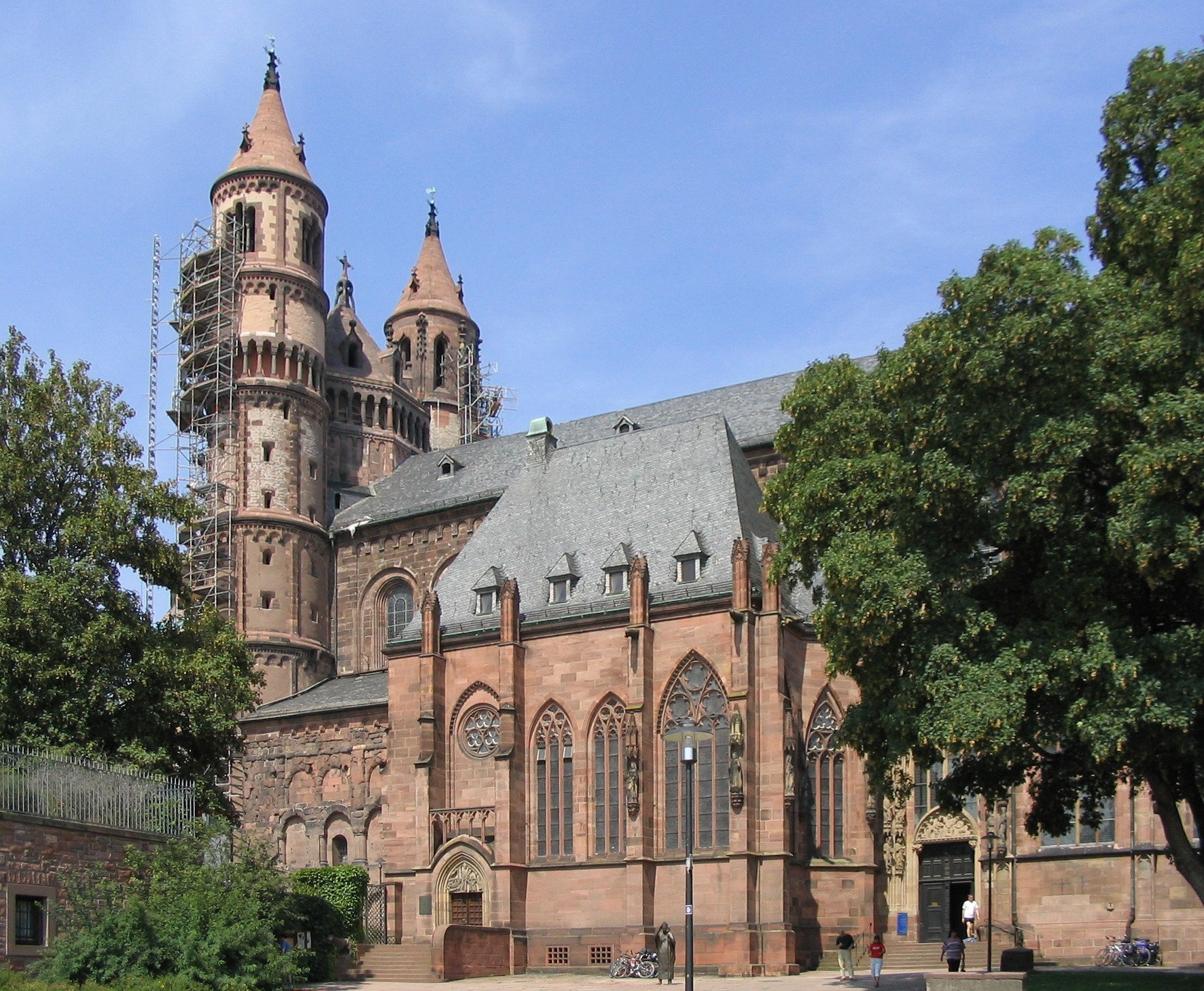
The city's dominant building is the Dom St. Peter, an 11th- and 12th-century Romanesque cathedral with four round towers and one of the finest Romanesque interiors in Germany. It is one of the three "Imperial Cathedrals" of the Rhineland (along with Speyer and Mainz), and it is the one where the Nibelungenlied sets a fateful meeting between Kriemhild and Brünhild. Just south of the cathedral, the Luther Monument (1868) is the largest Reformation monument in the world — Luther stands at the centre, surrounded by earlier reformers and allegorical figures representing Protestant cities.
The other essential stop is the Jewish Quarter, tucked against the north-eastern corner of the old city walls. Worms had one of the oldest and most important Jewish communities in Europe — a millennium of continuous presence until the community was destroyed in 1938–1945. The 11th-century Synagogue (the oldest in Germany, destroyed on Kristallnacht and rebuilt in the 1950s using original stones), the adjacent ritual bath (mikveh) dating to 1186, and the 1,000-year-old Jewish cemetery ("Heiliger Sand," the oldest surviving Jewish cemetery in Europe) together form a UNESCO World Heritage Site. It is a sobering, essential place. The nearby Rashi House Museum tells the story of the community in detail.
The Nibelungen theme runs through the city in statues and fountains — see the Nibelungen Museum inside the old town walls, and Hagen's statue sinking the treasure into the Rhine — and the Nibelungen Festival every August is a major open-air theatre event on the steps of the cathedral. Worms sits in the centre of Rhine wine country — the name Liebfraumilch originates here, from the Liebfrauenkirche vineyard, though modern quality Liebfraumilch is a long way from the sweet mass-produced stuff sold to tourists. Worms is an easy day trip from Mainz or Heidelberg and richly rewards a few hours of quiet wandering.