Würzburg is a city of about 130,000 people in northern Bavaria, set on both banks of the Main river in a fertile basin surrounded by the forested hills of the Spessart, Rhön and Steigerwald. It is the capital of Lower Franconia (Unterfranken), a region with its own strong identity — more Catholic, more wine-oriented and more Mediterranean-feeling than the rest of Bavaria — and one of the main wine-producing areas of Germany, specialising in the distinctive bottle-shaped Bocksbeutel flask and in refined dry Rieslings and Silvaner. For travellers, Würzburg is also the northern starting point of the Romantic Road (Romantische Straße), the signposted scenic route that runs south through Rothenburg ob der Tauber, Dinkelsbühl, Augsburg and eventually to Füssen and the Bavarian Alps.
The city's great monument is the Residenz, the vast 18th-century palace built for the prince-bishops of Würzburg by the baroque architect Balthasar Neumann. It is widely considered the finest baroque palace in Germany and is a UNESCO World Heritage Site. Its monumental staircase rises into an enormous unsupported vaulted ceiling painted in 1752–53 by Giovanni Battista Tiepolo — the largest single fresco ever created, a personification of the four continents that is one of the most extraordinary painted ceilings in Europe. Other rooms worth the visit are the Imperial Hall (Kaisersaal) and the Hofkirche. Miraculously, the Residenz survived the devastating 1945 bombing of the city that destroyed nearly everything else. The adjacent Martin von Wagner Museum in the south wing holds the university's art collection.
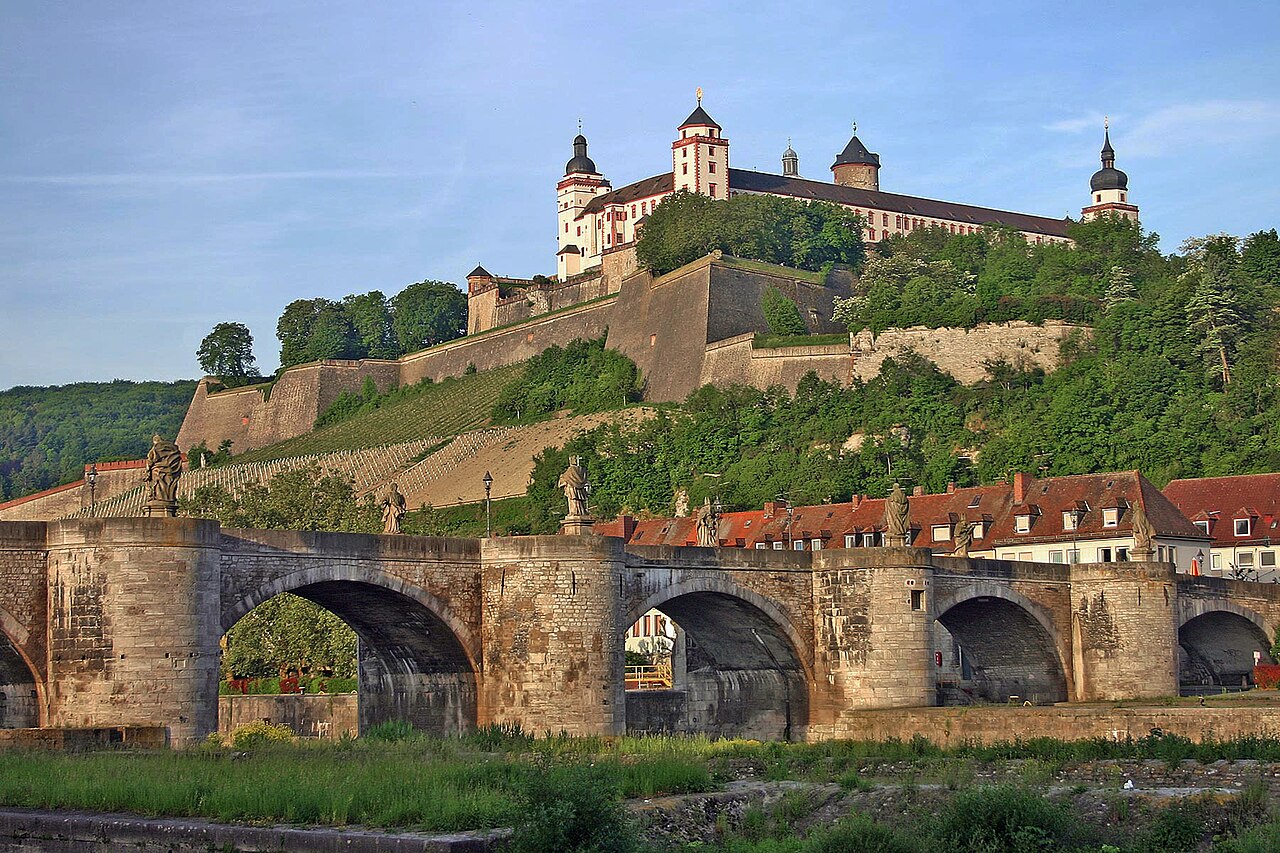
Above the river on the opposite bank rises the Marienberg Fortress, the former residence of the prince-bishops, reached by a steep climb or by a small ferry and a bus. The fortress now houses two museums, including the Museum für Franken with one of the finest collections of German Gothic sculpture in the country — especially the works of Tilman Riemenschneider (c. 1460–1531), the late-Gothic master who lived and worked in Würzburg and whose emotional, almost pre-modern wood figures are the defining art of the region. Down in the old town, the Alte Mainbrücke (Old Main Bridge) is lined with baroque statues of saints and is the classic place to buy a glass of wine from one of the adjacent Weinstuben on a summer evening and watch the sun set over the fortress — an essential Würzburg ritual known locally as "Brückenschoppen".
The Würzburg Cathedral and the adjacent Neumünster are the spiritual centre of the old town, with a history going back to the Irish missionary St. Kilian. The Marienkapelle on the market square is a fine late-Gothic chapel. In the physics institute on Röntgenring, the Röntgen Memorial Site marks where Wilhelm Röntgen discovered X-rays in 1895 — one of the most important scientific discoveries ever made, in a room you can still visit. The Juliusspital wine estate is the best place to try the local Franken wines, including the distinctive Silvaner and Scheurebe. For modern and contemporary art, the Museum im Kulturspeicher in a converted riverside granary holds a strong collection.