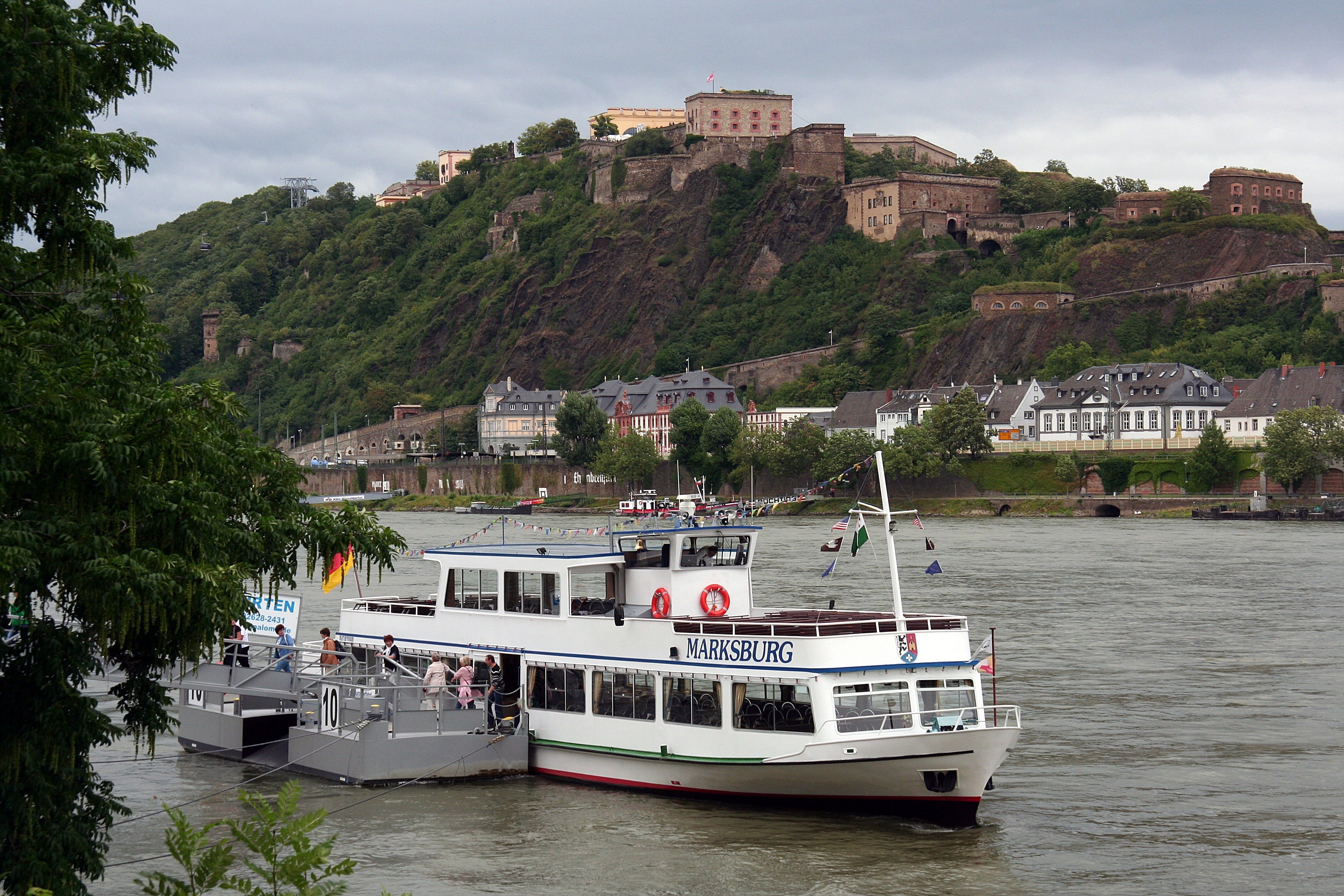
Koblenz sits at one of the great geographical confluences of Europe: the Deutsches Eck, or German Corner, where the Moselle flows into the Rhine. It is a natural crossroads, and has been occupied continuously since Roman times. The city was bombed heavily in the Second World War and much of the old town was rebuilt, but it retains its dramatic setting — the fortress of Ehrenbreitstein on the opposite bank of the Rhine is one of the largest preserved fortresses in Europe, and offers views over the confluence that explain why every army in history wanted to hold this spot.
The old town is pleasant to walk through, with the Liebfrauenkirche and the Jesuitenkirche among the notable buildings, and the Münzplatz and Florinsmarkt as attractive squares. Wine is the main pleasure here — Koblenz sits at the northern end of the Moselle wine region, and Riesling and Spätburgunder are served freely in the local Weinstuben. The Rhine Gorge stretching south toward Bingen is a UNESCO World Heritage Site: a procession of vineyards, medieval castles, and the Lorelei rock that has inspired poetry and legend for centuries.
Koblenz makes a practical base for exploring the Middle Rhine and Moselle valleys, with good rail connections to Cologne to the north and Mainz to the south. The cable car crossing to Ehrenbreitstein is a highlight in itself.