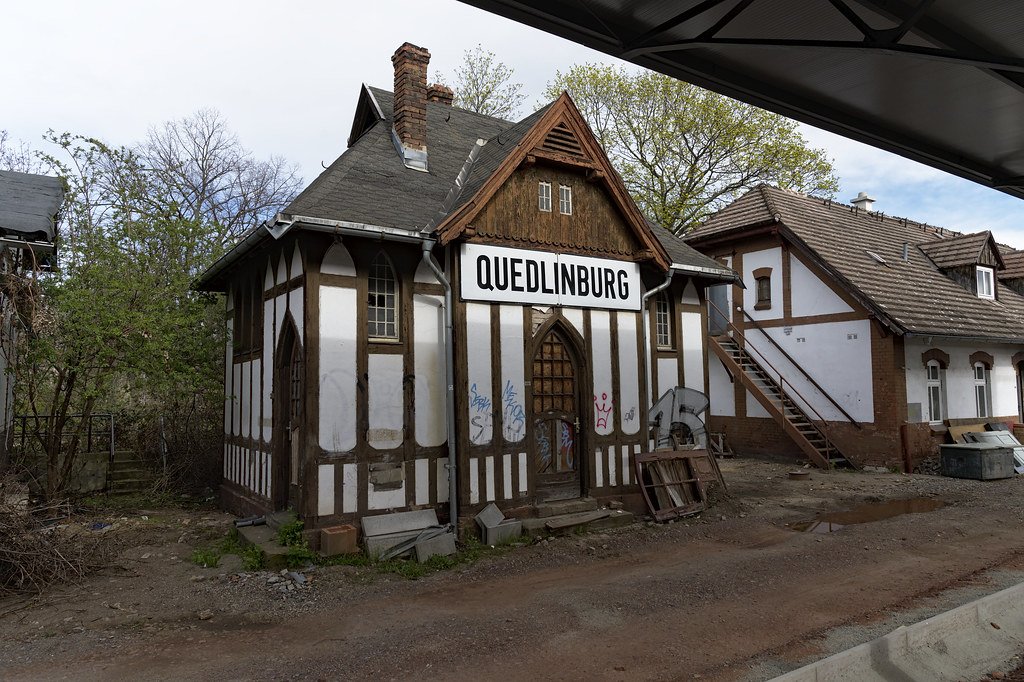
Quedlinburg is one of the best-preserved medieval towns in Germany, a UNESCO World Heritage Site on the northern edge of the Harz Mountains in Saxony-Anhalt. The old town contains over 1,300 half-timbered houses spanning six centuries, from the 14th to the 19th, making it one of the largest collections of timber-frame architecture in Europe.
The town is dominated by the Schlossberg, a sandstone hill topped by the Collegiate Church of St. Servatius, a Romanesque masterpiece whose crypt houses the tombs of the first German king, Henry I, and his wife Matilda. The church treasury, one of the finest in Germany, was famously looted by an American soldier in 1945 and not fully recovered until the 1990s.
Below the hill, the streets are a delight to wander — narrow lanes of crooked, painted houses leaning at angles that seem to defy structural engineering. The Finkenherd neighbourhood and the streets around the Marktplatz are the most photogenic. Quedlinburg also has an unexpected connection to the Bauhaus: Lyonel Feininger lived here in the 1920s, and a small gallery on the Schlossberg shows his work.
The Harz Mountains begin just south of town, offering hiking in summer and cross-country skiing in winter. The narrow-gauge Selketalbahn steam railway runs from Quedlinburg into the mountains.