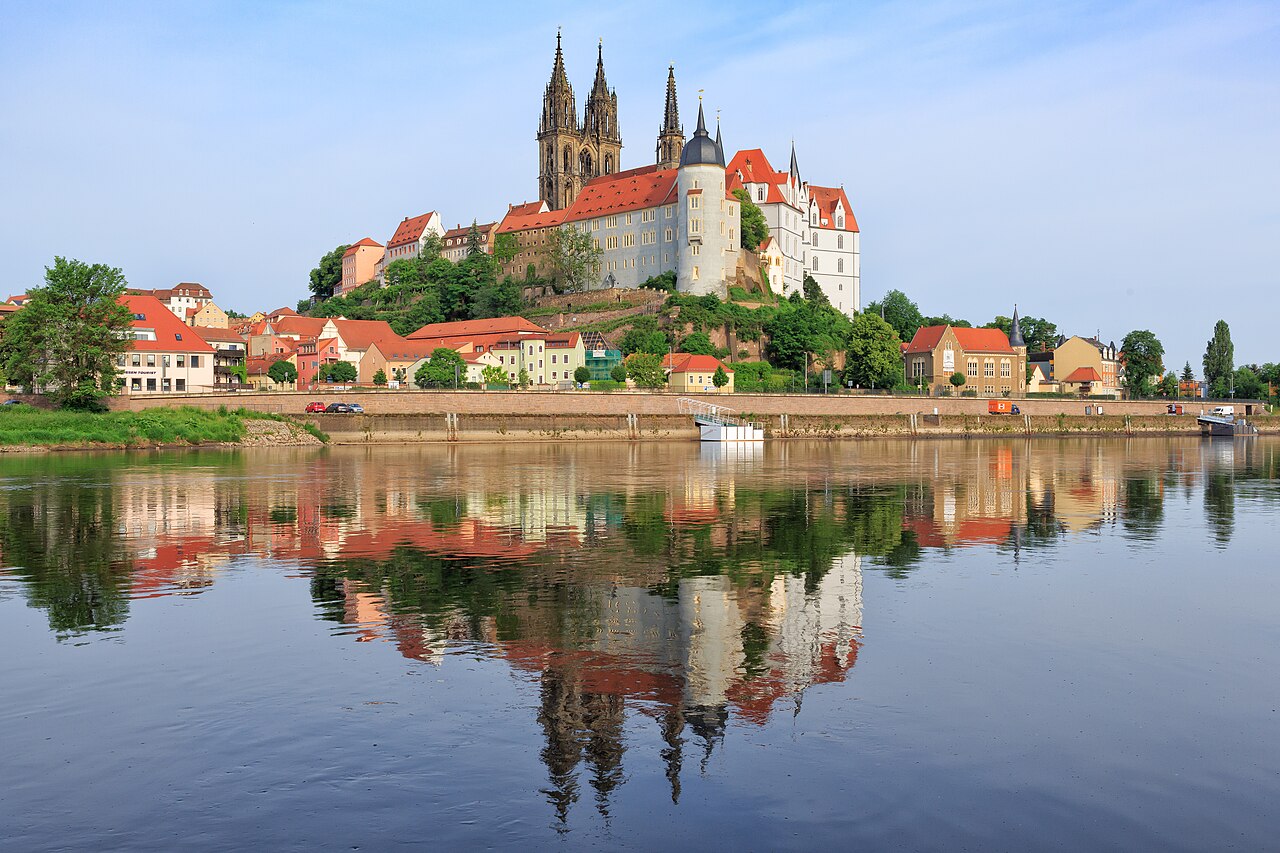
Meissen is a small city on the Elbe about 25km northwest of Dresden, famous across Europe as the birthplace of European hard-paste porcelain. The Meissen factory was established in 1710 when Augustus the Strong, Elector of Saxony, set alchemist Johann Friedrich Böttger to work producing something to rival Chinese porcelain. The result was the white gold that bears the city's name, still produced here and marked with the crossed blue swords trademark.
The old town climbs above the Elbe to a hilltop crowned by Albrechtsburg Castle and Meissen Cathedral, one of the most striking medieval silhouettes in Saxony. The castle, built between 1471 and 1524, was one of the first large residential palaces in Germany — and served for over 150 years as the secret factory where Meissen porcelain was produced under lock and key. The Cathedral next door contains notable Gothic altarpieces, medieval tombs, and a set of early Meissen porcelain figures. The Altmarkt and the streets below the hill are compact and worth wandering.
The city is also a good base for the Saxon wine country — Saxony is one of Germany's northernmost wine-producing areas, and the steep slopes above the Elbe produce distinctive whites, particularly Müller-Thurgau and Riesling. Day trips to Dresden are easy, and the Elbe cycle path connects the two cities.