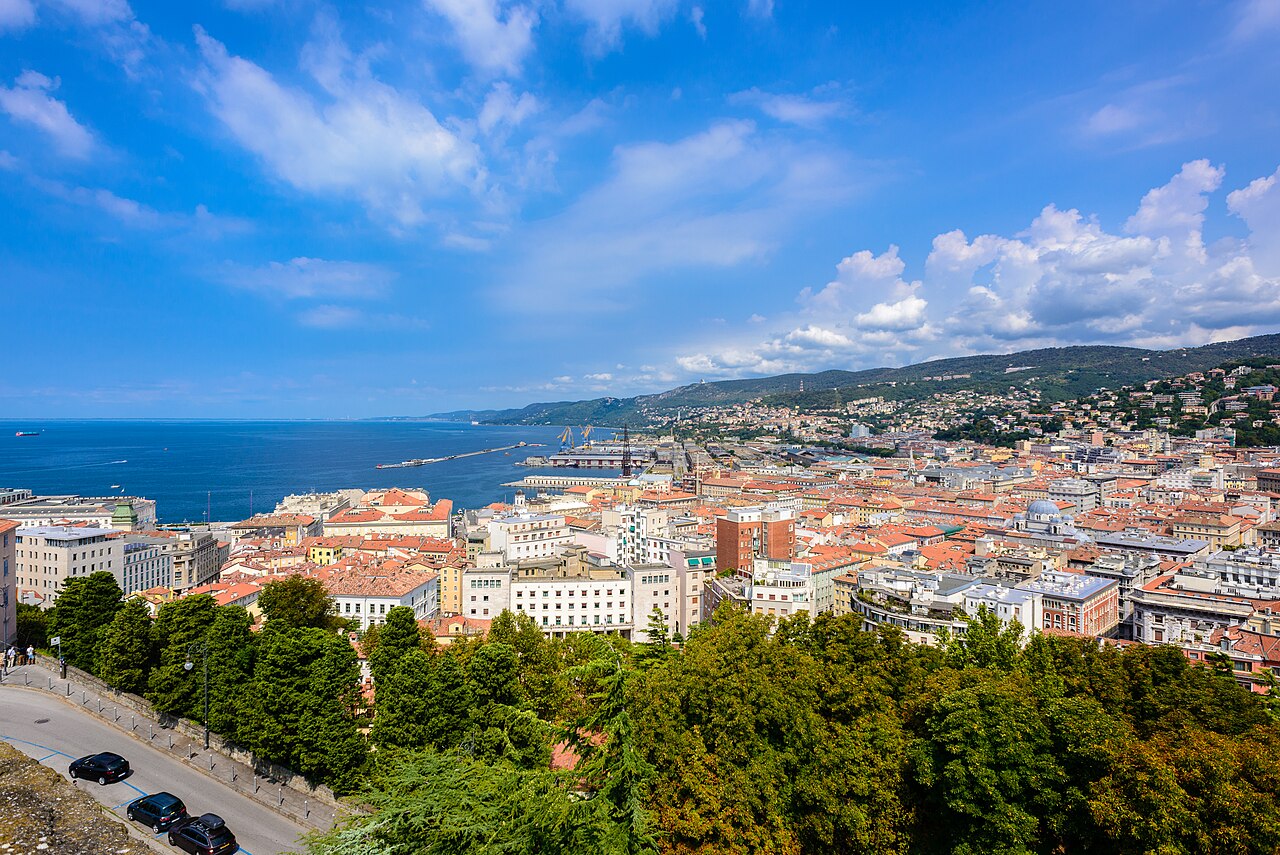
Trieste is the most northerly port of Italy, perched on the Adriatic where the Mediterranean meets Mitteleuropa. For two centuries it was the great seaport of the Habsburgs — a free port grafted onto the Austrian Empire — and it still feels less Italian than Central European, with a Slovenian hinterland on its doorstep and the limestone Carso plateau looming above the harbour. The city has a faded grandeur and a literary, melancholy atmosphere that has attracted writers from James Joyce and Italo Svevo to Jan Morris.
The heart of the city is Piazza Unità d'Italia, one of the largest sea-facing squares in Europe — three sides framed by monumental Habsburg palaces, the fourth open to the Gulf. From here it is a short walk to the Roman theatre, the Canal Grande lined with cafés, and the Cattedrale di San Giusto on the hill above, with its conjoined Romanesque basilicas and Roman ruins. North along the coast sits Castello di Miramare, the white neo-Gothic folly built for the doomed Archduke Maximilian, who left from here to become emperor of Mexico and never came back.
Trieste's other defining feature is its café culture. The city has the highest per-capita coffee consumption in Italy and a vocabulary of its own — order a capo and you'll get what the rest of Italy calls a macchiato. The grand 19th-century coffee houses, Caffè San Marco and Caffè degli Specchi above all, have survived almost unchanged: marble tables, vaulted ceilings, newspapers on racks, an atmosphere of unhurried conversation. Joyce wrote much of Dubliners in places like these, and his friend Svevo, the Triestine novelist Joyce championed in Paris, was a regular alongside him.
Outside the centre, the Carso plateau is studded with caves — Trieste is where speleology was born — and dotted with osmize, temporary farmhouse wine bars that locals follow by word of mouth. Watch out for the bora, the cold north-easterly wind that funnels down from the karst and reaches speeds that have, on occasion, required ropes to be strung along the streets. Many of the 19th-century villas are visibly worn at the edges, but that is part of the city's charm: a cosmopolitan port that history left behind, slowly becoming itself again.