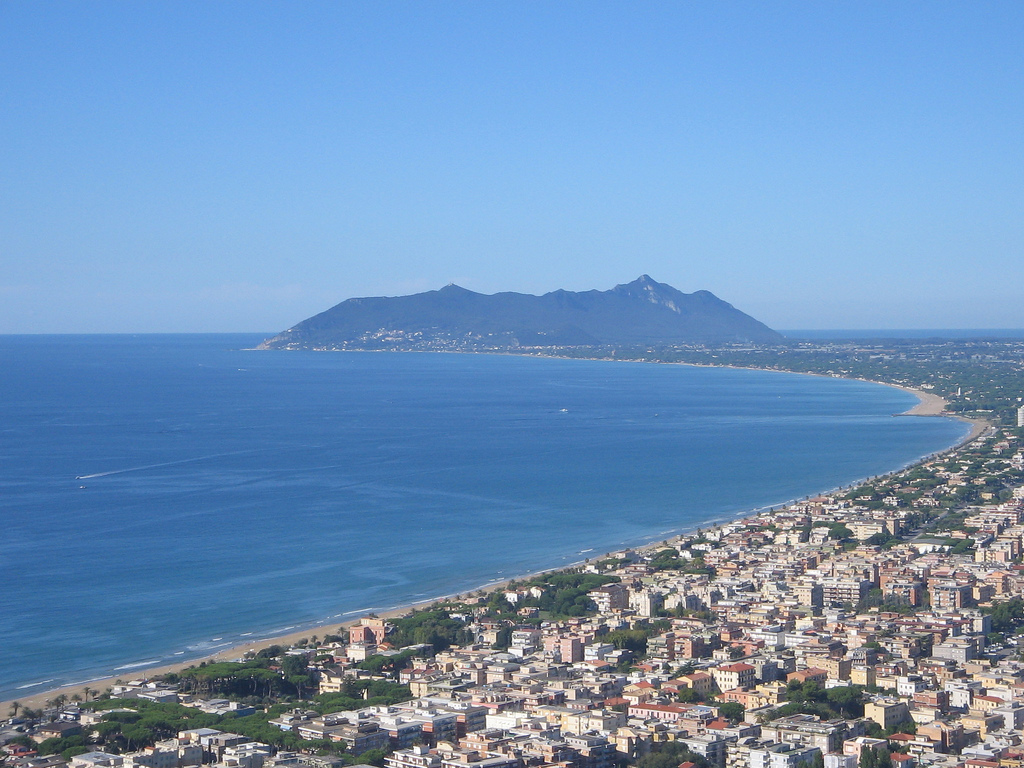
Coastal Lazio town where Roman ruins crown a beachside split between seaside promenade and hilltop old quarter.
Terracina is a coastal town in southern Lazio, halfway between Rome and Naples along the old Via Appia. It splits into two parts: a modern seaside town along the beach, and the atmospheric upper town (centro storico) built over ancient Roman ruins on the hillside above.
The highlight is the Temple of Jupiter Anxur on Monte Sant'Angelo, above the old town. The terrace of the ruined temple has sweeping views over the Tyrrhenian Sea and the Pontine Plain — on a clear day you can see the islands of Ponza. Down in the old town, the main piazza sits directly on top of the ancient Roman forum, the stonework still visible below; the Terracina Cathedral incorporates ancient Roman columns into its portico.
The beach below is long and sandy, popular with Roman day-trippers in summer. Terracina is less touristy than the Amalfi Coast and makes a pleasant stop on the coastal route between Rome and Naples.
Guide
Beaches
Terracina's beach runs south from the town along the Riviera di Ulisse — a long arc of sand that stretches toward the Circeo headland. The beach is clean and pleasant, divided between free public stretches and stabilimenti balneari (private lido operations) that rent umbrellas and sunbeds. The private lidos are well-run and include showers and beach bars; the free sections are more basic but perfectly usable.
The beach gets busy with Roman day-trippers in July and August. If you want more space, head further south toward Fondi or north toward San Felice Circeo, where the crowds thin out. The water is clear and the Tyrrhenian is calm most of the summer — good for swimming and paddling.
Guide
Getting There
The Terracina railway station is not on the main Rome-Naples railway line. The nearest stops are the station of Priverno-Fossanova or that of Monte San Biagio : the former has a shuttle rail connection to Terracina, with hourly departures.
Terracina can be reached by car from Rome by the old Via Appia, which goes on to Fondi , or by the more modern Via Pontina as far as Latina , and then through a direct road link running along the coast. The Via Flacca connects the city to Sperlonga and Gaeta to the south coast. A fast road link leads to the Frosinone exit of the A1 Rome-Naples highway