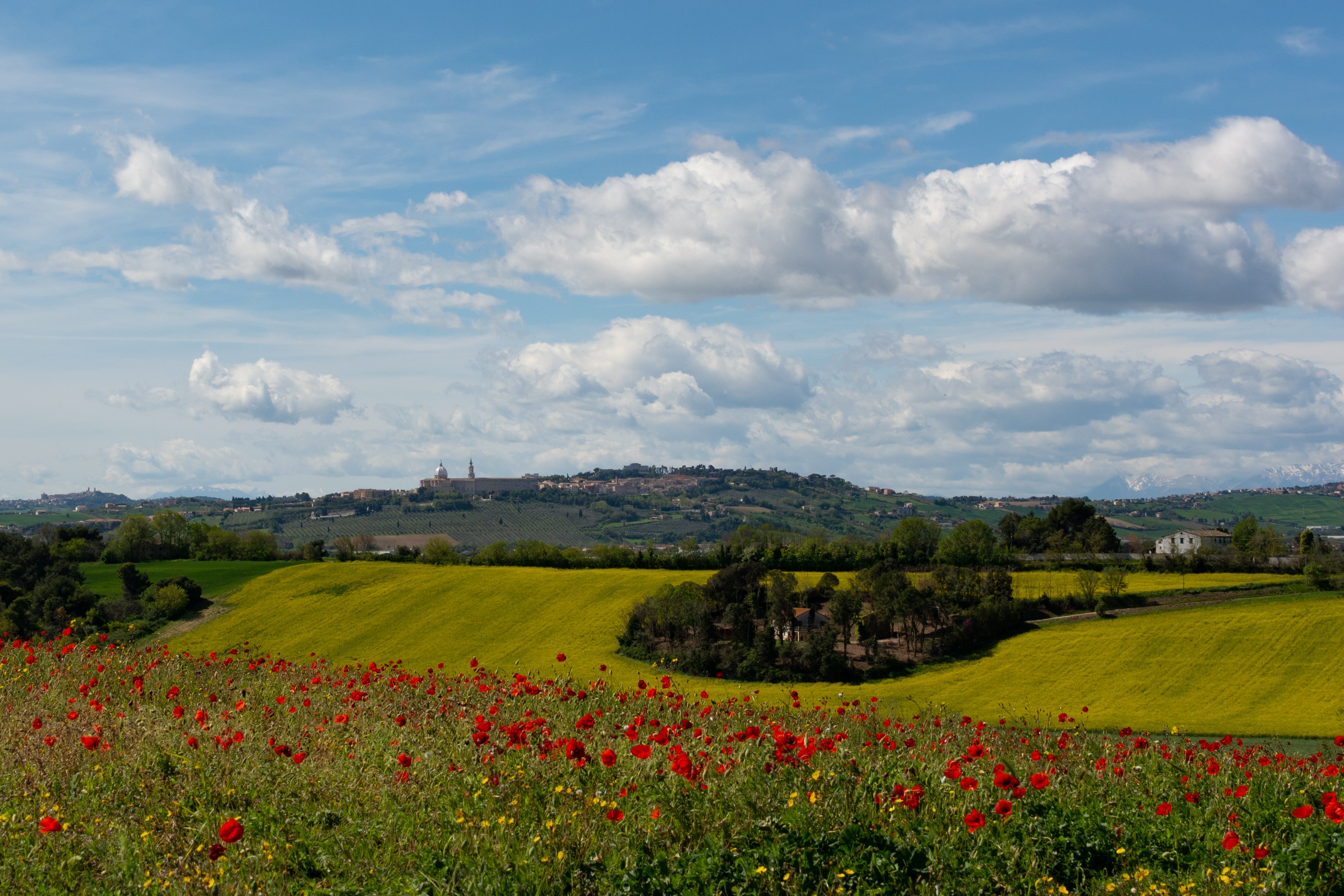
Loreto sits on a hill fifteen kilometres south of the Riviera del Conero, and for centuries it has drawn pilgrims from across the Catholic world. It is one of the most important Marian shrines in Europe, and the whole town — its walls, its long arcaded piazza, its hospices for travellers — grew up to receive the crowds who come to see a single small building.
That building is the Holy House, the stone dwelling traditionally identified as the home of the Virgin Mary in Nazareth, said to have been carried to Loreto by angels in 1294. It stands enclosed within the Basilica della Santa Casa, sheathed in an astonishing marble screen carved by some of the greatest names of the Italian Renaissance — Bramante drew the design, with sculpture by Sansovino, Sangallo and others. Whatever you make of the legend, the artistry of the setting is undeniable, and the basilica's domed silhouette dominates the surrounding countryside.
There is more here than the pilgrimage. The Apostolic Palace, ranged around the piazza, holds a series of late altarpieces by Lorenzo Lotto, who spent his final years as an oblate at the shrine — among the most moving works of his career. The town's ramparts give wide views toward the Adriatic and the hills of the Marche.
Loreto is busiest in summer and around the great Marian feast days, when the pilgrim crowds are heavy; come early in the morning to have the Holy House to yourself. It pairs naturally with Recanati, a few kilometres inland, for a day spent away from the beach.