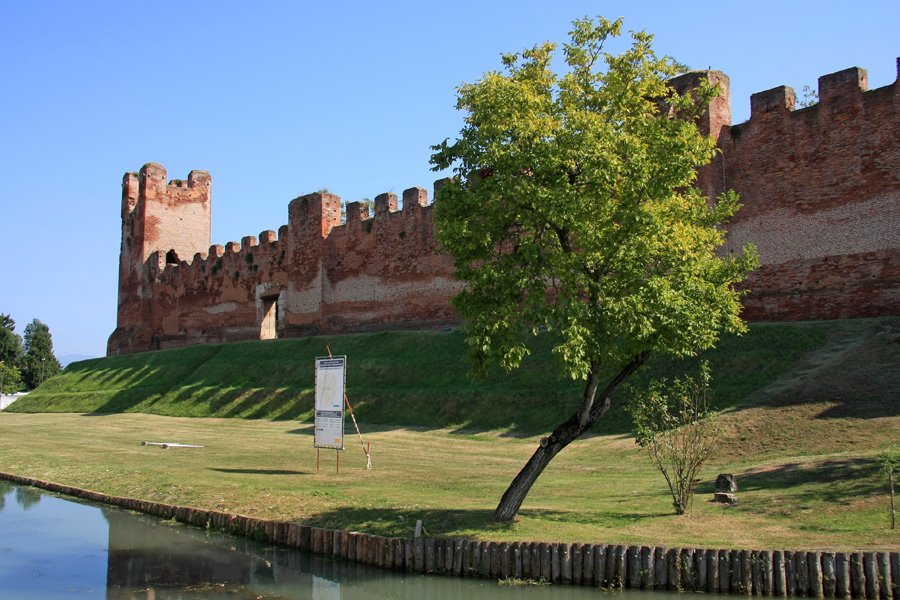
Castelfranco Veneto is a walled town on the Venetian plain, halfway between Treviso and Bassano del Grappa. The old centre is a near-perfect medieval fortress — a rectangular ring of brick walls and towers built around 1199 by Treviso as a frontier outpost, with a moat that has been turned into a green park ringed by lime trees. The whole thing is small enough to walk around in twenty minutes and is one of the more attractive small historic centres in the Veneto.
The town's great claim to art history is that the painter Giorgione was born here in the late 1470s. His one signed surviving painting, the Castelfranco Madonna, hangs in the Duomo just inside the walls — a strange, dreamlike enthroned Virgin between two saints, with a landscape behind that prefigures Venetian painting for the next century. The painter's birthplace, now a small museum, is around the corner. Outside the walls, the town flattens out into a busy provincial centre with the usual mix of shopping streets, market squares and ring roads.
Castelfranco makes an excellent base for the Venetian villas. Villa Emo at Fanzolo, eight kilometres east, is one of Palladio's finest country houses, with frescoes throughout by Zelotti. The Brion tomb at San Vito di Altivole, ten kilometres north, is Carlo Scarpa's most concentrated late masterpiece. Combine the two with an afternoon inside the walls of Castelfranco and you have a day of Venetian architectural history from the High Renaissance to the late twentieth century.