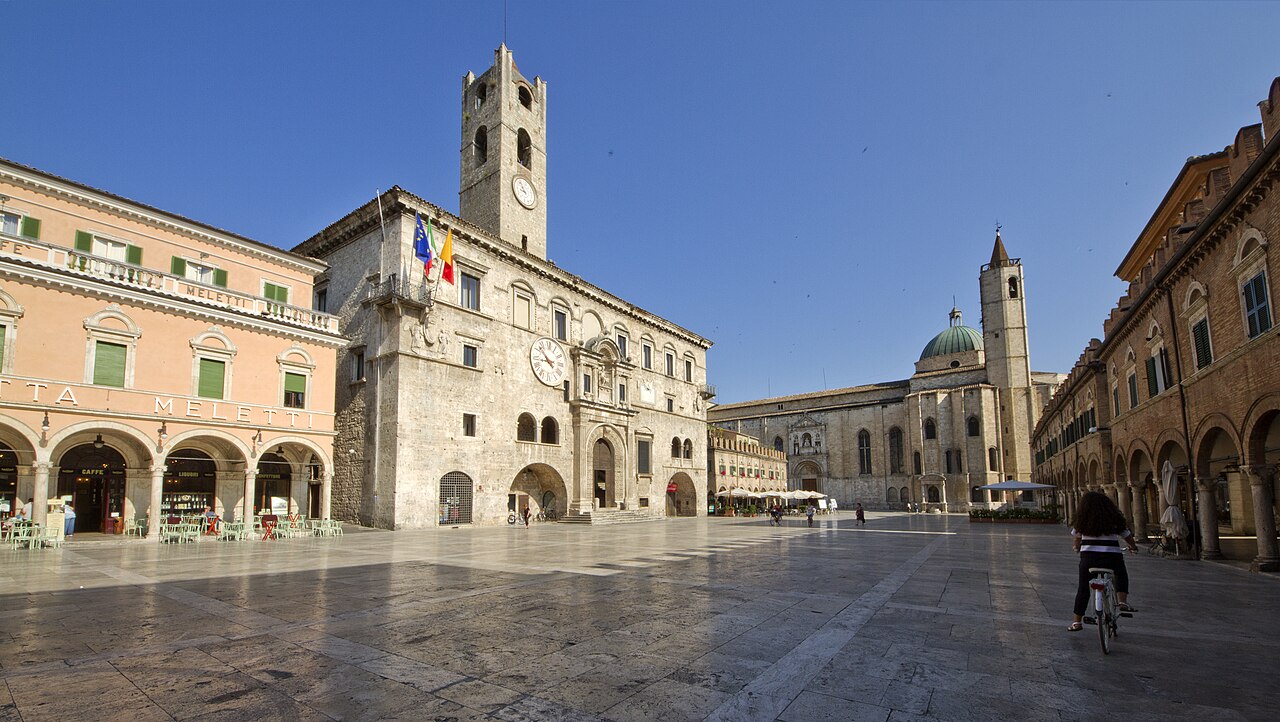
Ascoli Piceno sits where the Tronto river meets the Castellano, ringed by mountains on three sides — the Sibillini to the north, the Monti della Laga to the south. It is one of the most handsome small cities in Italy, and one of the least visited: the entire centre is built from travertine, a pale grey stone quarried from the surrounding hills, which gives the place a quiet, unified elegance that photographs don't quite capture.
The heart of it is the Piazza del Popolo, a long Renaissance square of travertine paving framed by the Palazzo dei Capitani del Popolo and the Gothic church of San Francesco. The cafés along the colonnades — especially Caffè Meletti — are the place to sit with a coffee and watch the town go about its business; the evening passeggiata here is unhurried and unchanged for generations. Beyond the square, narrow medieval streets lead past fifty or so surviving towers (there were once more than two hundred), the Cathedral of Sant'Emidio with its Carlo Crivelli altarpiece, and the Roman bridge over the Castellano.
Ascoli comes alive twice a year for the Quintana, a Renaissance jousting tournament held on the first Sunday of August (and again in July), when six knights representing the city's six neighbourhoods ride at a target in full costume. Nine hundred locals turn out in medieval dress for the parade that precedes it. If you can time your visit around it, do.
The town is a good base for the two national parks that flank it, and a natural stop on any drive between Rome and the Adriatic. It sees few foreign tourists, which is part of the appeal — and the olive ascolane (stuffed, fried olives) that originated here are worth the trip on their own.