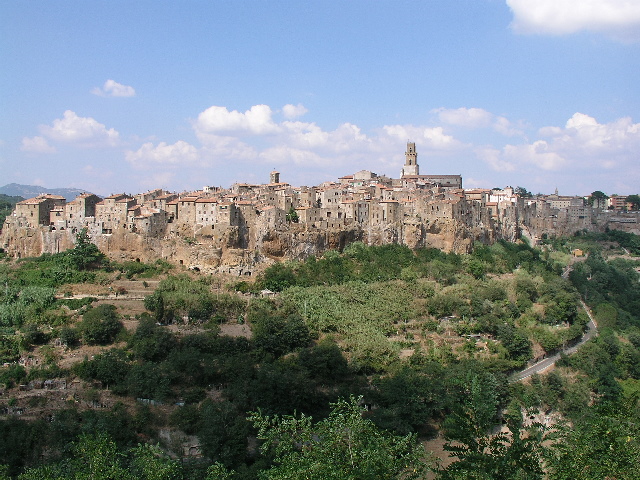
Dramatic southern Tuscan town built on volcanic tuff cliffs above wooded Etruscan valleys.
Pitigliano sits on a narrow spur of volcanic tuff in the deep south of Tuscany, three hundred metres above the surrounding valleys, its buildings clinging to the cliff edge so closely that from the road below the town and the rock appear to be a single formation. It is one of the most dramatic townscapes in central Italy, and it is still largely unknown outside the region.
The landscape here is nothing like the rolling hills of Chianti. South Tuscany is wild country — volcanic tuff, deep wooded gorges, thermal springs, and the Maremma plain running to the coast. The area was the heartland of the Etruscans, and their presence is everywhere: cave tombs cut into the cliffs, and above all the vie cave — ancient sunken roads carved ten or twenty metres deep into the soft rock, running for kilometres between the hilltop towns. They are extraordinary and largely unvisited.
In the 16th century Pitigliano became home to one of the largest Jewish communities in rural Tuscany. The town was known as "La Piccola Gerusalemme" — the Little Jerusalem — and the remains of that community, its synagogue, bakery, mikveh, and cellars, have been preserved as La Piccola Gerusalemme, a museum of real depth.
The Palazzo Orsini dominates the western end of town, a fortified palace built by the family that ruled here for three centuries before the Medicis arrived. The caves carved into the tuff beneath the streets — used for millennia as cellars, sheds, and refuges — can be explored on guided tours that depart from the museum. The local white wine, Bianco di Pitigliano, is clean and very drinkable. Nearby Sorano and Sovana are worth a half day each.
Guide
Day trips from Pitigliano
Sorano
One guide book says it is grey and boring, another says it is a great town. It looks beautiful from the road and is worth a visit.
Sovana
Fabulous small town with two good churches. The one in the center of town has excellent stone carvings and bits of frescoes. Many stores, restaurants and cafes, but it is a very small town. You park on the edge of town and walk in. See the Etruscan tombs west of Sovana, just off the highway.
Saturnia
Drive on to Saturnia for lunch at I Due Cippi da Michele or one of the other fine restaurants. This town is very upscale and beautiful, but small. There is an original Roman arch and a bit of old Roman road at the edge of the town. The famous Saturnia spa and hot springs are just down the road.
Guide
When to Go
Spring (April and May) is the best time to visit Pitigliano. The tuff hillsides are green, the light is clear, the crowds have not arrived, and the vie cave are at their most atmospheric with the damp of winter still in the rock. Summer (June to August) is hot and increasingly busy, particularly in July and August when northern Italian and German tourists fill the town.
September and early October are excellent — the vintage is underway, the heat eases, and the olive groves around the town are preparing for harvest. Winter is quiet to the point of feeling empty; many restaurants and shops reduce their hours or close. The surrounding Maremma landscape in winter, when the wild boar are hunted and the forests are bare, has a bleakness that suits its character.
The Festival of Lights (Torciata di San Giuseppe) takes place on 19 March: a torch-lit procession through the dark lanes of the old town, a tradition that predates the current saint's-day framing and has the atmosphere of something much older.