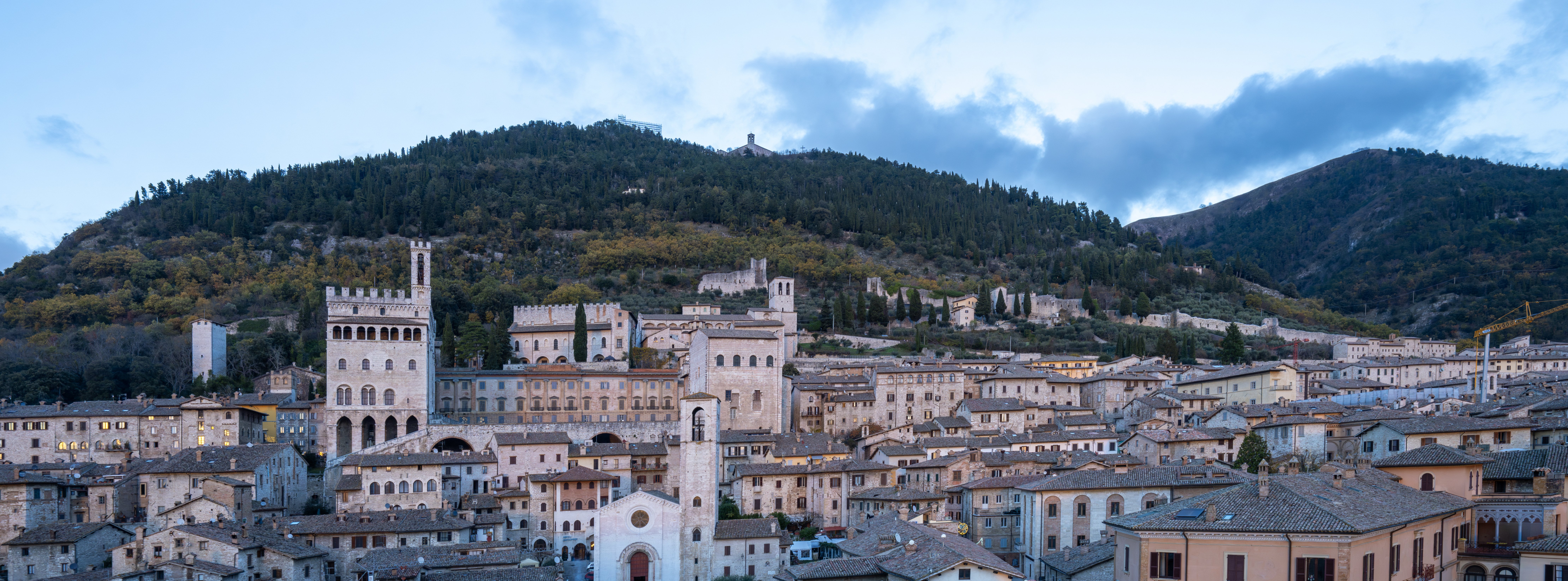
Gubbio is the most convincingly medieval town in Umbria — possibly in all of Italy. Its grey stone streets climb steeply up the flank of Monte Ingino, its towers and palaces intact, its walls unbroken. There is no major highway running through, no sprawling suburb to negotiate. You arrive, you walk in, and you are five centuries back.
The town sits about 40 km north of Perugia and a similar distance from Assisi. It was the Roman municipium of Iguvium, and the ruins of a 1st-century theatre survive on the edge of town. In the Middle Ages Gubbio became a thriving commune — its citizens fought off Perugia under the leadership of Bishop Ubaldo, whose preserved body still lies in the basilica on the hill above. That hill defines the town: from Piazza Grande, the great hanging square that is Gubbio's centrepiece, you look out over the valley while Monte Ingino presses against your back.
The ceramics tradition here goes back to the 16th century, and the workshops still turn out lustrous majolica. Gubbio is also serious about truffles — white truffle season (autumn) is a good excuse to visit if you need one. The town hosts the Corsa dei Ceri each May, a wild medieval race up the mountain carrying enormous wooden pillars, which the locals treat with complete seriousness.