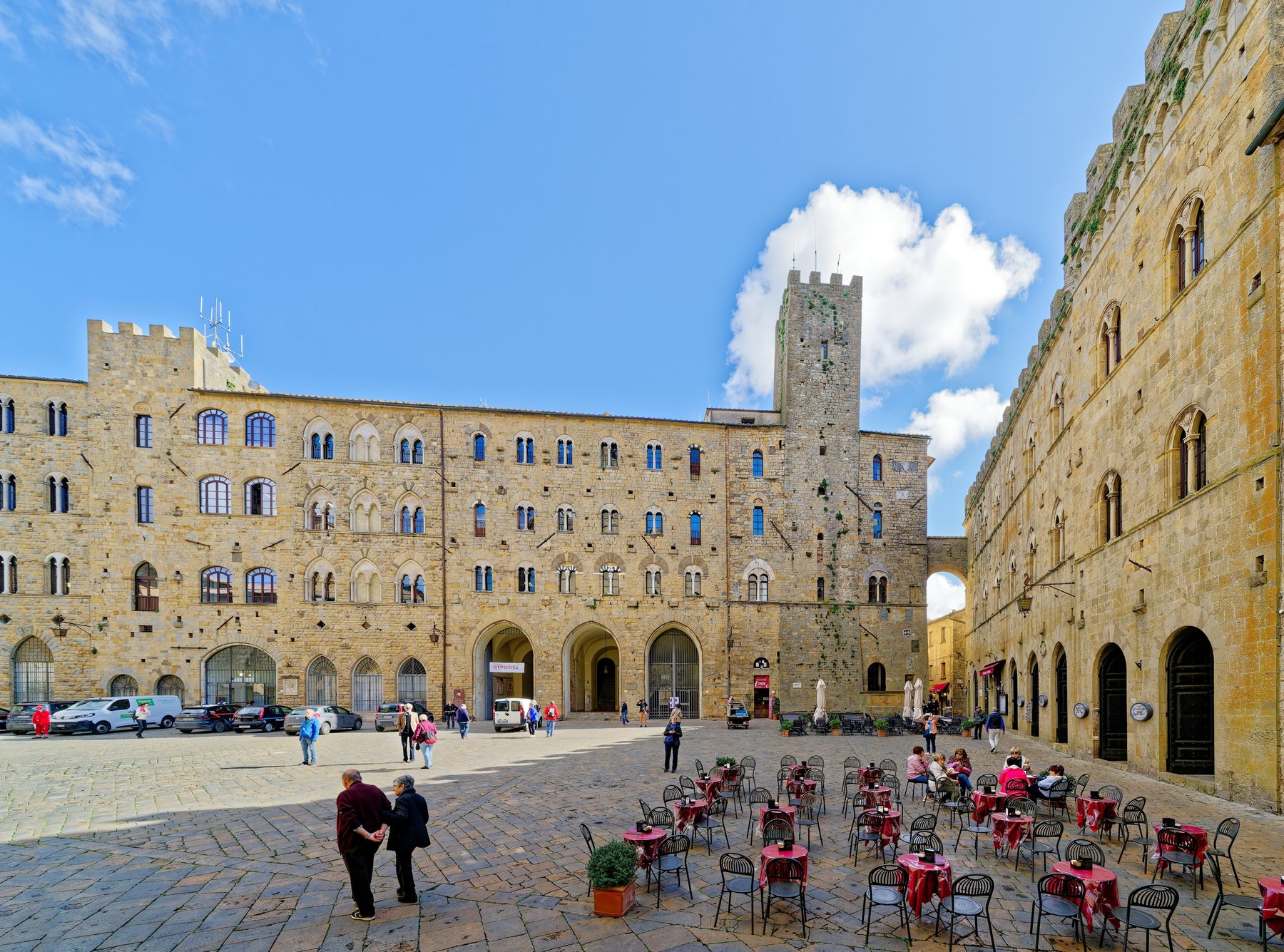
Volterra sits 545 metres above sea level on a dramatic ridge in the Tuscan hills, looking out over the Cecina and Era valleys. It is less visited than Siena or San Gimignano, which is precisely the point — you can walk its narrow stone streets without feeling like you are in a theme park.
The town is ancient in the truest sense. The Etruscans settled here before Rome was a city, and traces of their civilisation — walls, urns, the Porta all'Arco gateway — sit alongside medieval towers and Renaissance palaces. The Etruscan finds fill the magnificent Museo Guarnacci, one of the oldest public museums in Europe. The Romans left a fine theatre, the Teatro Romano, still buried up to its lower tier in medieval rubble that paradoxically saved it. The medieval town gathers around the Piazza dei Priori and its 13th-century Palazzo dei Priori, the oldest town hall in Tuscany.
The local stone is alabaster, a creamy translucent material that has been quarried and carved here for over two thousand years. Volterra's craftsmen still work it today, and the alabaster workshops along the main street are worth a look.
The landscape around the town is remarkable. Directly to the west, Le Balze — deep clay chasms carved by erosion — have slowly eaten into the hillside for centuries, swallowing an Etruscan necropolis and a medieval church. The effect is strange and quietly unsettling. The brooding Fortezza Medicea crowns the highest point of the town; it has been a prison for five centuries and still is one.
Volterra is a half-day town for most visitors coming from Florence or Siena, but it rewards a night's stay. Once the day-trippers leave, the streets belong to residents, and the town shows its real character — modest, self-contained, and pleasingly indifferent to tourism.