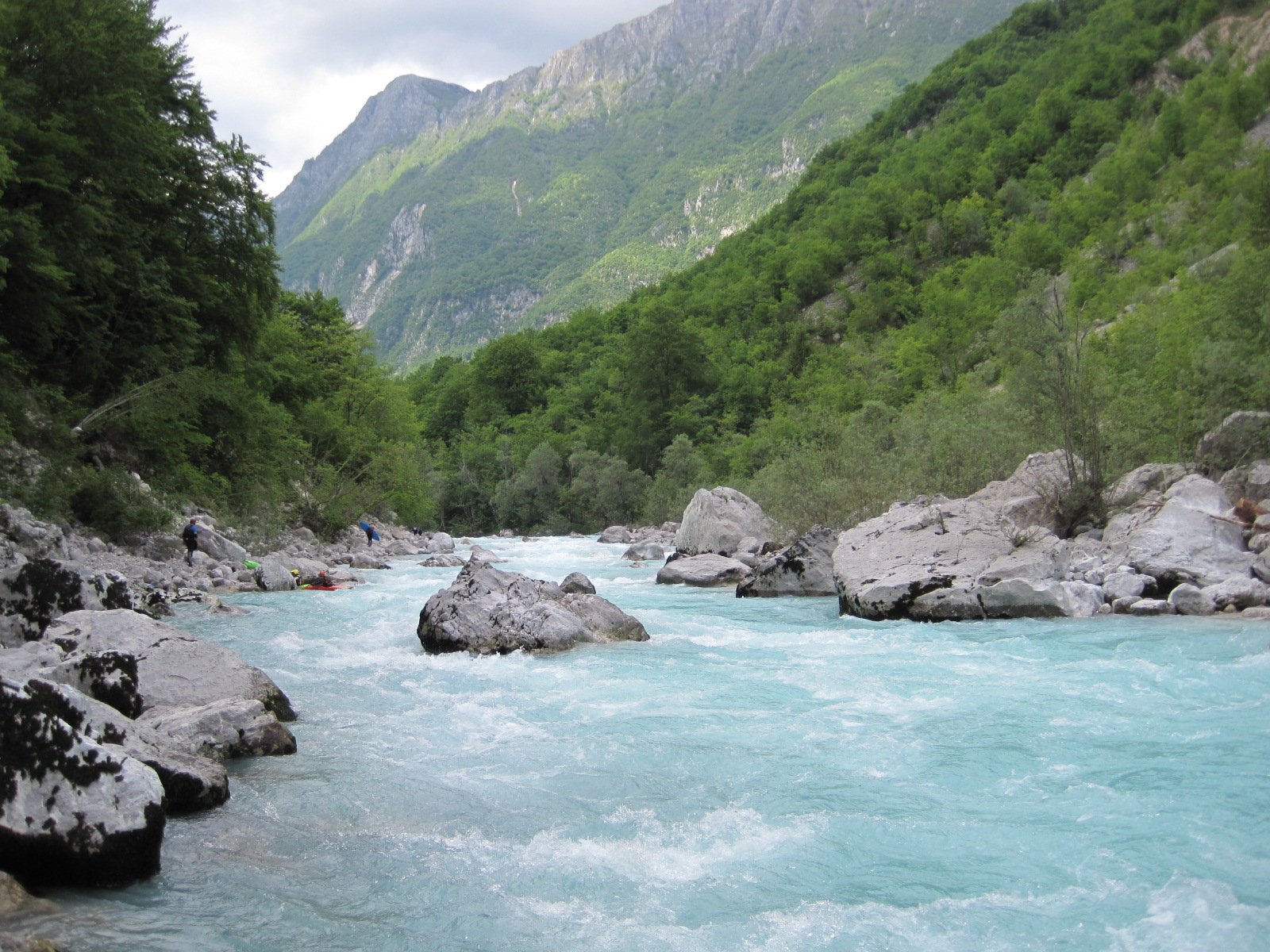
Julian Alps river valley defined by the turquoise Soča, First World War history, and outdoor sports.
The Soča Valley runs southwest through the Julian Alps from the Vršič Pass to the Italian border, carrying one of the most beautiful rivers in Europe. The Soča (Isonzo in Italian) is famous for its colour — an astonishing turquoise-green, as if someone had poured glacial melt into a tropical sea. It has been photographed, painted, and described in superlatives for two centuries, and the reality still surprises first-time visitors.
The valley is divided into two distinct zones. The upper valley, centred on Bovec, is the adventure-sports heartland: white-water kayaking and rafting on the Soča, canyoning in its side gorges, and paragliding from the slopes above. The town of Kobarid — known to the wider world as Caporetto, site of one of the decisive battles of the First World War — anchors the lower valley, where the river broadens and the gorge walls relax into vine terraces and apple orchards.
The military history is inescapable. From 1915 to 1917, the Soča Front was among the most brutal theatres of the First World War, with Italian and Austro-Hungarian forces fighting over these same valleys and ridges. Ernest Hemingway served as an ambulance driver here — his experience on the Isonzo Front became A Farewell to Arms. The Kobarid Museum is one of the finest First World War museums in Europe, and the Italian Charnel House above the town holds the remains of thousands of soldiers.
The natural setting rewards those who slow down. The Soča Trail follows the river from its source to the Italian border on a marked path. The Boka Waterfall — the highest in Slovenia — crashes 144 metres into a gorge near Bovec. The Kluže Fortress, built across a narrow defile to control the approach from the north, is a perfectly preserved piece of Habsburg military engineering.
Guide
Books
A Farewell to Arms by Ernest Hemingway (1929). Hemingway drove ambulances on the Isonzo Front in 1918 and drew directly on that experience for this novel. Lieutenant Henry's retreat from Caporetto — the Battle of Kobarid — is one of the most vivid pieces of writing about the chaos of military collapse. Reading it before visiting makes the landscape and the Kobarid Museum resonate very differently.
The White War: Life and Death on the Italian Front 1915–1919 by Mark Thompson (2008). A detailed and unsparing history of the Italian campaign on the Soča/Isonzo, covering the eleven Battles of the Isonzo in sequence. Thompson's research in Italian and Austro-Hungarian sources makes this the most thorough account in English of what happened in this valley.
Alamut by Vladimir Bartol (1938). Not directly about the Soča Valley, but this Slovenian novel — a fictional account of the Assassins of medieval Persia — is one of the most significant works of Slovenian literature and worth reading to understand something of the Slovenian intellectual tradition.
Guide
When to Go
The Soča Valley is accessible year-round but has distinct seasons. Spring (April to June) is the best time for white-water sports — the snowmelt swells the river and the conditions are at their most exhilarating. The valley is also lush and green after winter, and crowds have not yet built.
Summer (July and August) is busy, particularly at weekends when visitors pour in from the Slovenian and Italian lowlands. The weather is reliably hot and sunny; the river is lower and clearer, showing its colour at its most intense. Accommodation should be booked ahead.
Autumn (September and October) is arguably the finest season: the tourist pressure eases, the beech forests turn gold and orange on the slopes, and the weather often remains good into October. Walking conditions are excellent.
Winter is quiet and cold. The ski area at Kanin operates from December to April. The Vršič Pass is closed by snow from roughly November to May; the valley is still accessible from the south via Italy or via the lower Soča.