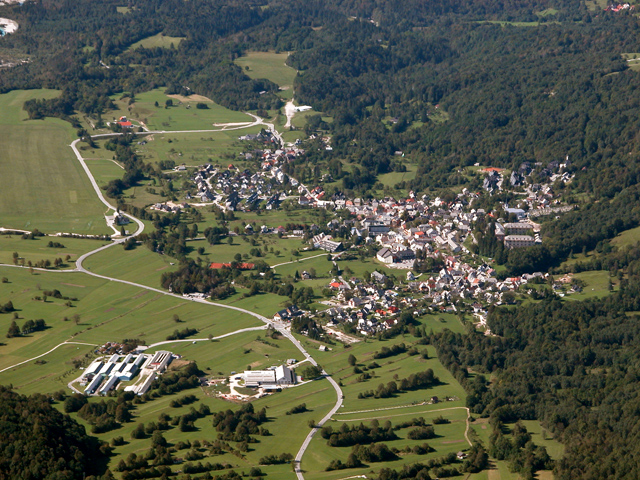
Soča Valley mountain town in the Julian Alps, known for rafting, canyoning, and emerald river water.
Bovec is a small mountain town in the upper Soča valley in northwestern Slovenia, surrounded by the Julian Alps. It is the adventure-sports capital of the country. The Soča river — famous for its extraordinary emerald colour — runs through the valley and is one of the best white-water kayaking and rafting rivers in Europe. Canyoning, zip-lining, and paragliding are all well-established here.
In winter, the Kanin ski resort above Bovec is the highest in Slovenia, with snow-sure slopes and views into Italy. The Vršič Pass, connecting the Soča valley to Kranjska Gora over the Julian Alps, is one of the most spectacular mountain roads in Europe and can be combined with a visit to the source of the Soča at its northern end.
The Boka Waterfall, the highest in Slovenia, is a short hike from the main road. Kluže Fortress, built by the Austro-Hungarians above a narrow gorge, adds a WWI dimension to the valley — the mountains around Bovec were the Isonzo Front for three years of brutal fighting. The town itself is small and functional — a base for activities rather than a destination in its own right — but the surrounding landscape is genuinely extraordinary.
Guide
Getting There
Bovec is in a mountain valley with no train service. By car from Ljubljana, take the A1 motorway south toward Koper, exit at Razdrto, and then follow the E61 toward Nova Gorica and north through the Soča valley — the total distance is about 130 km and takes around two hours. Alternatively, approach from the east via Kranjska Gora and the spectacular Vršič Pass (closed in winter), which adds time but gives extraordinary views.
From Italy, the Predel Pass road connects Bovec to the Friuli road network. In summer, buses run from Nova Gorica and Ljubljana via the Soča valley corridor, though frequency is limited. Several tour operators in Ljubljana offer day trips to the Soča valley in summer.
Guide
When to Go
The Soča valley is at its most dramatic in late spring and early summer (May to July), when the river runs full from snowmelt and the surrounding mountains are still snow-capped. White-water conditions are best in May and June. The water temperature rises enough for comfortable swimming by July and August, which are the peak months — the valley fills with visitors and accommodation should be booked well ahead.
September and early October are excellent: the crowds thin, the light softens, and the beech forests on the valley sides turn gold. White-water rafting continues until late October. Winter brings skiing on Kanin from December; the valley floor is often clear of snow even when the resort is fully operational.