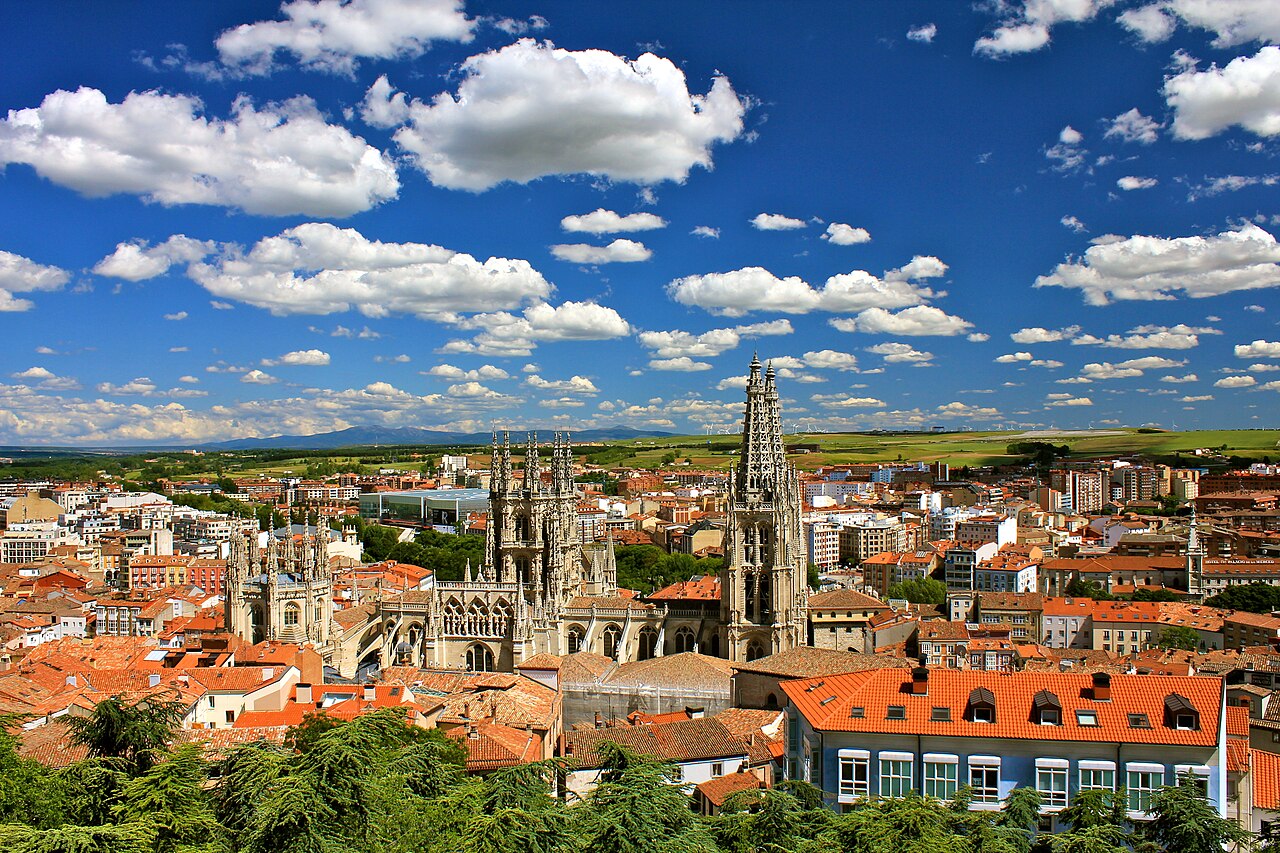
Burgos is one of the great Gothic cities of Spain, dominated by its cathedral — a UNESCO World Heritage Site whose delicate spires and flying buttresses are visible from every approach to the city. Completed in the thirteenth century and modelled on the French cathedral at Bourges, it houses the tomb of El Cid, the legendary knight of the Reconquista, and his wife Jimena.
The city sits on the high meseta of Castilla y León, on the Camino de Santiago pilgrim route, and its character is shaped by that setting — austere, cold in winter, proud. Beyond the cathedral, the old town is rich in Gothic churches: San Nicolás de Barí with its extraordinary stone retablo, and Santa Gadea, where El Cid reportedly forced King Alfonso VI to swear an oath of innocence. Las Huelgas monastery, founded by Alfonso VIII, houses the royal pantheon of medieval Castile and a superb museum of medieval textiles. The castle ruins above the city give wide views over the meseta.
The Cartuja de Miraflores, three kilometres east of the centre, is a rival attraction to the cathedral for sheer artistic impact — its gilded altarpiece and alabaster royal tombs are among the finest late Gothic works in Europe. And the Museum of Human Evolution on the riverbank is world-class, telling the story of the Atapuerca archaeological sites just outside the city where fossils 800,000 years old have rewritten the history of early humans in Europe.
The tapas scene along Calle San Lorenzo and the streets around the Arco de Santa María is one of the best in northern Spain — Burgos is famous for its morcilla (blood sausage) and roast lamb.