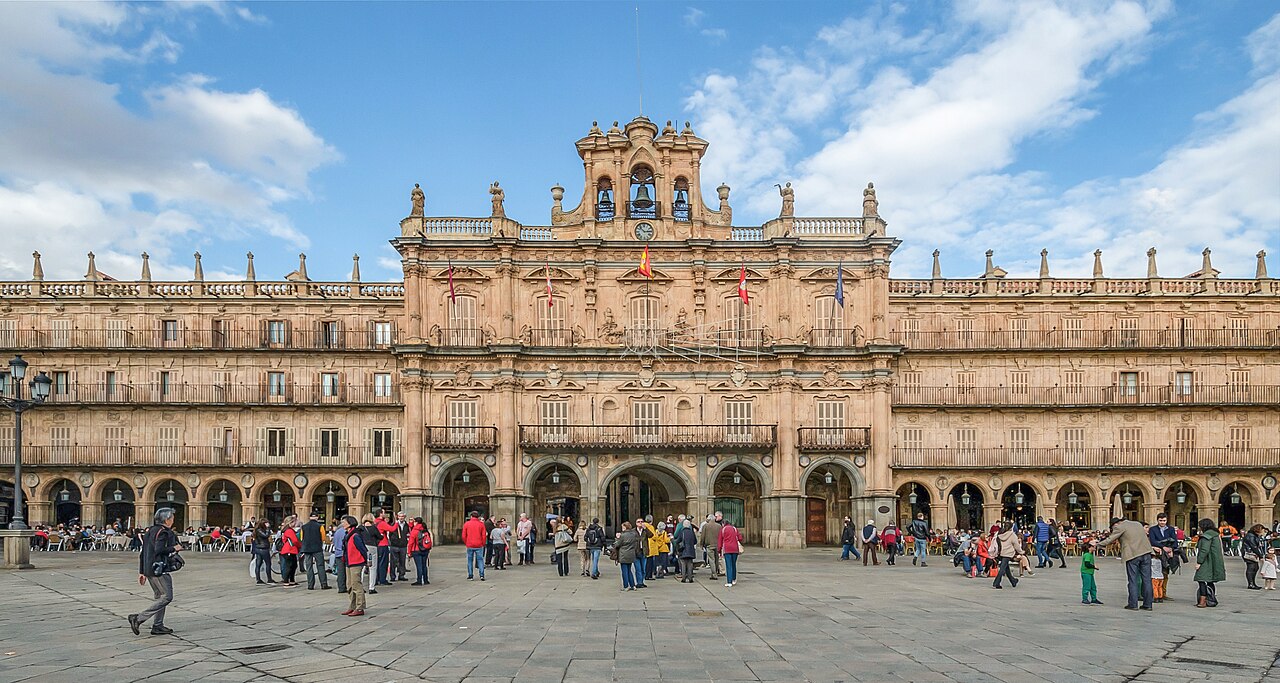
Salamanca is a honey-coloured university city on the banks of the Tormes river in western Spain, about two and a half hours north-west of Madrid by train. It is one of the most beautiful old cities in Spain and — for my money — the best small city to visit in the country after Granada. The whole historic centre is built from Villamayor sandstone, a soft, pale-gold stone that hardens in the air, takes carving beautifully, and glows in the evening sun. UNESCO declared the old town a World Heritage Site in 1988, and one afternoon of walking through it is enough to understand why.
The heart of Salamanca is the Plaza Mayor, generally considered the finest town square in Spain and arguably the finest in Europe. Designed by Alberto de Churriguera in 1729, it is a perfectly enclosed baroque rectangle lined with arcades, cafés, and medallion portraits of Spanish royalty and historical figures carved into the keystones above the arches. There is a Franco medallion here that locals defaced and which the city has left in its damaged state. Sit with a coffee at one of the terraces in the evening, when the stone turns orange and the city's 30,000 students start to fill the square, and you'll understand why Salamanca is the Spanish city students and foreign visitors most fall for.
The University of Salamanca, founded in 1218 by King Alfonso IX, is the third-oldest surviving university in Europe after Bologna and Oxford, and it is still the city's beating heart. The old Escuelas Mayores building has the most lavishly carved plateresque façade of the 16th century — the city's tradition is that you must find the tiny carved frog perched on a skull on the façade to ensure good luck in exams (and tourists now spend minutes searching for it). Inside, the Biblioteca Antigua preserves 50,000 manuscripts and incunabula.
The city's other essential sights are the Cathedrals (Salamanca has two attached to each other — the old 12th-century Romanesque Cathedral Vieja, and the new 16th-century Gothic Cathedral Nueva, which was still being built in 1733 when a Mexican Franciscan stonemason carved a small astronaut into one of its façade panels during a restoration, creating a much-photographed anachronism); the Casa de las Conchas, a 15th-century mansion decorated with some 300 carved scallop shells; and the Convento de San Esteban, whose plateresque façade is almost as elaborate as the university's. Eat the local hornazo (a meat-stuffed pie), drink the local Sierra de Salamanca wine, and don't rush through the city — Salamanca rewards slow travel more than almost any other Spanish destination.