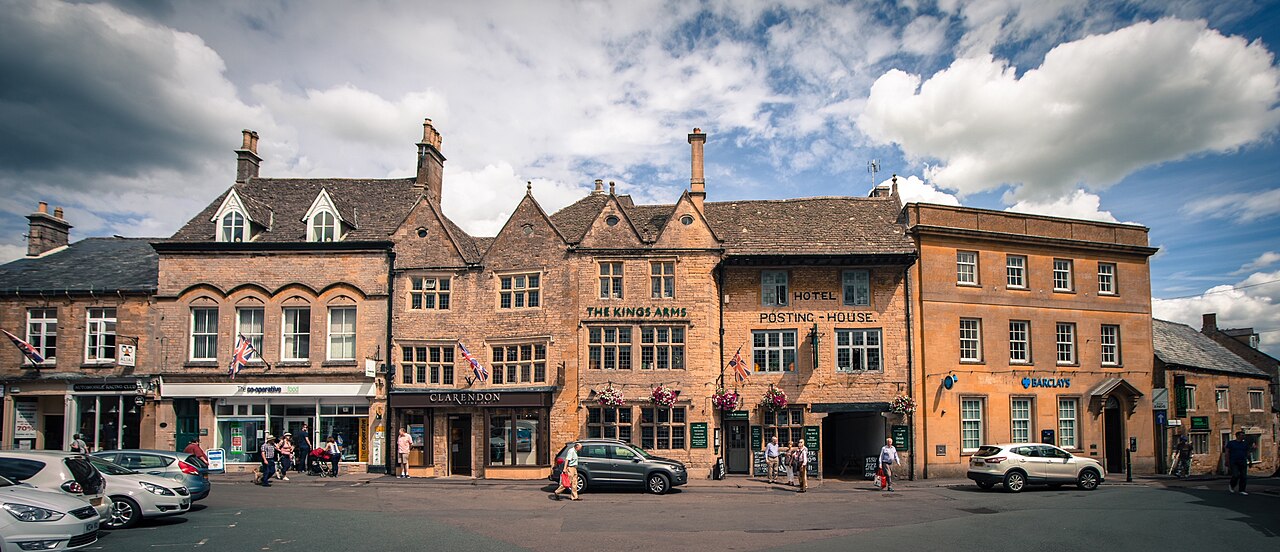
Cotswold market town on the Fosse Way, centred on a large old sheep-trading square
Stow-on-the-Wold is one of the most famous of the Cotswold towns, perched at the highest point on the ancient Fosse Way in northeastern Gloucestershire. The large market square — once used for huge sheep fairs that could see twenty thousand animals change hands in a day — is now ringed by antique shops, tea rooms, and honey-coloured stone buildings. The narrow alleys running into it, called "tures," were built to funnel livestock; now they channel tourists.
St Edward's Church anchors the north end of the square, its north door famously framed by two ancient yew trees. The church served as a prison for Royalist soldiers captured at the Battle of Stow-on-the-Wold in March 1646 — the last pitched battle of the English Civil War, fought on ground just north of the town.
Stow is also England's most concentrated antique-dealing centre, with around forty dealers operating in a town of two thousand people. The antique shops along Sheep Street and Church Street range from single-room specialists to large multi-dealer centres. The town makes a good base for exploring the northern Cotswolds: Bourton-on-the-Water is a short drive south, and the rolling countryside between here and Chipping Norton is quintessential English landscape.
Guide
Getting There
Stow-on-the-Wold has no railway station — the old line closed in 1962. The nearest train stations are Moreton-in-Marsh (5 miles east, on the Cotswold Line from Oxford and London Paddington) and Kingham (6 miles southwest, also on the Cotswold Line). Both are served by Pulhams Motor Coaches bus routes connecting to Stow.
By car the town sits at the junction of the A429 (Fosse Way), A436, and A424, making it easy to reach from the M40 (junction 8 for Burford, or junction 15 for Warwick). Parking can be difficult in summer; the main car park is on Fosseway Road.
Coaches from London (National Express and others) stop at Moreton-in-Marsh. From there, local buses or taxis cover the remaining distance.
Guide
When to Go
Stow-on-the-Wold is busiest in summer (June to August), when the Cotswolds draw large numbers of visitors and the town can feel crowded. Spring and autumn are quieter and often equally pleasant — the light on the Cotswold stone is particularly good in October.
The twice-yearly Stow Horse Fair brings large numbers of travellers to the area in May and October. The fair has taken place for centuries and is a genuine social event for the Romani and Irish Traveller communities, though it has also generated controversy and increased policing in recent years. It is worth knowing about if you're planning to be in the area on those dates.
Winter is cold — the town sits at 800 feet and the local verse has it right: "Stow-on-the-Wold, Where the wind blows cold." But it's also quiet, and the antique shops and tea rooms are still open. Christmas markets and seasonal events make December a reasonable time to visit if you don't mind the chill.