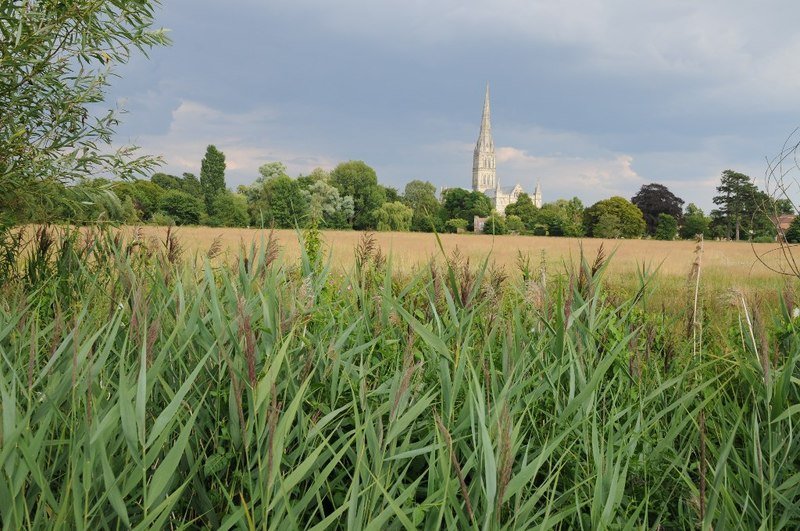
Salisbury is a compact cathedral city in Wiltshire where the medieval skyline still belongs entirely to the church. The spire of Salisbury Cathedral rises to 123 metres — the tallest in England — and is visible for miles across the surrounding chalk downland. On a clear day you can see it from Old Sarum, the Iron Age hillfort north of town where the original settlement stood before the city moved to its present site in the thirteenth century.
The cathedral close is one of the finest in England: a walled precinct of Georgian townhouses, medieval canons' lodgings, and manicured lawns that encircles the cathedral on all sides. Mompesson House, an elegant Queen Anne mansion owned by the National Trust, faces the north walk. Just across the close, the Salisbury Museum in the King's House holds the best collection of Stonehenge material anywhere — including the skeleton of the Stonehenge Archer — and makes an essential stop before heading to the stone circle itself.
The old town beyond the close rewards aimless wandering. The Market Place has been the commercial heart of Salisbury since the thirteenth century and still runs markets on Tuesdays and Saturdays. The medieval Poultry Cross at the market's edge is one of only four surviving market crosses in England. Half-timbered buildings cluster along the lanes nearby, including the fifteenth-century Hall of John Halle, now the foyer of the cinema on New Canal.
Salisbury is the obvious base for visiting Stonehenge, just fourteen kilometres north-west. But do not overlook the stone circle at Avebury — less famous but in many ways more impressive, since you can walk among the stones.