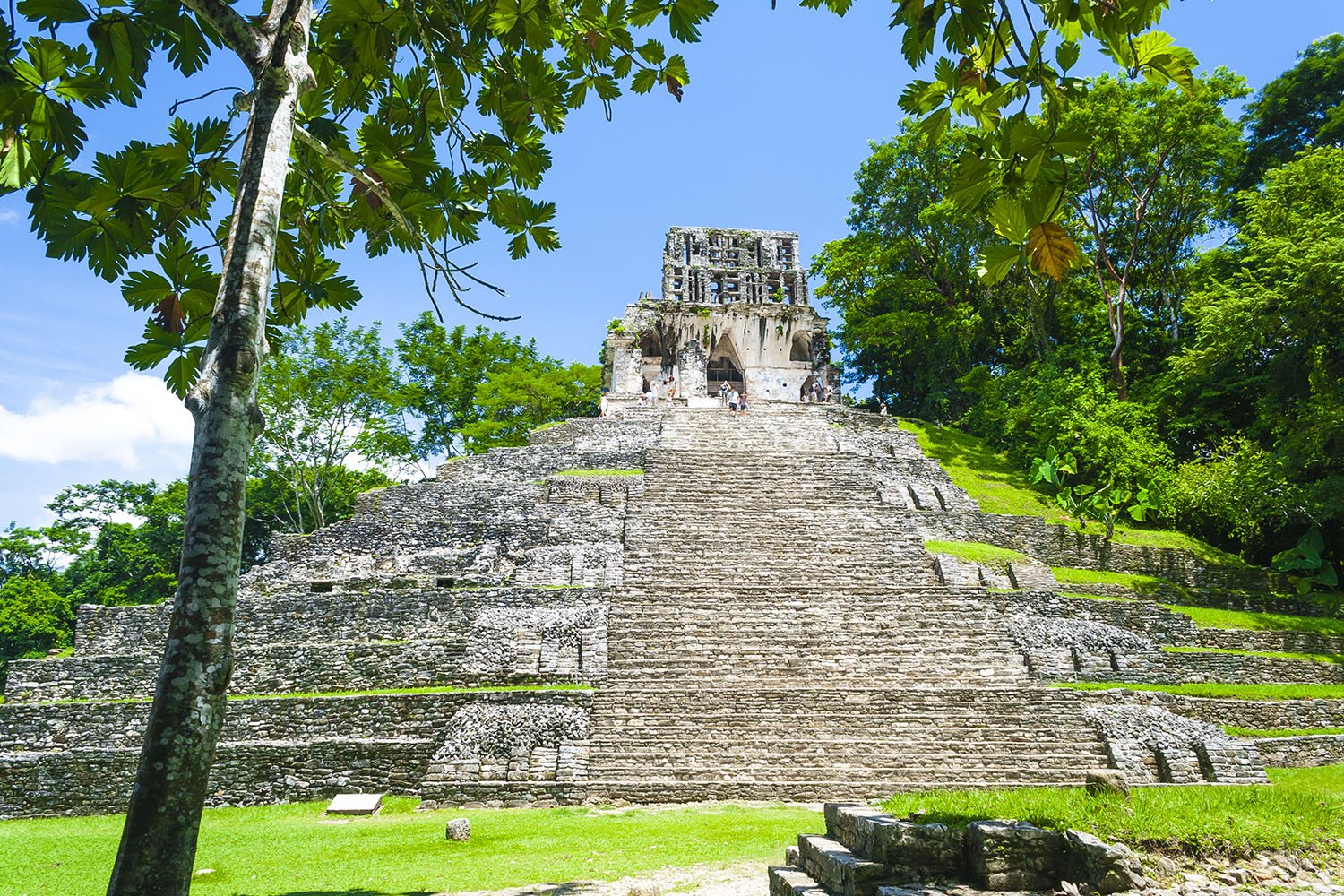
Chiapas gateway town below jungle-covered Maya ruins at the wet edge of the Gulf lowlands.
Palenque sits in the foothills of the Sierra Madre de Chiapas, where the highlands drop towards the Gulf Coast lowlands and the jungle gets thick and wet. Most travellers come for the ruins — the ancient Maya city of Palenque, set into a forested hillside at the edge of the modern town, is one of the finest archaeological sites in the Americas.
The modern town of Palenque itself is a small, functional place: a main square, a market, a cluster of hotels and restaurants aimed at the steady stream of visitors. It is not especially beautiful, and nobody comes for the town. But it is a convenient base, and the evening light on the zócalo, with the sound of birds returning to roost in the surrounding trees, has its own modest charm.
The ruins — officially the Palenque National Park — occupy a hilltop covered in jungle about 8 kilometres from the town centre. Only a fraction of the ancient city has been excavated; the rest lies under the trees. What you can see is extraordinary. The Temple of the Inscriptions houses the intact tomb of the 7th-century ruler Pakal the Great, discovered in 1952 — the first pyramid tomb found in the Americas. The Palace, the Temple of the Sun, and the carved sarcophagus lid are among the most refined works of Maya art anywhere.
Beyond the ruins, the area has a few day trips worth taking: the Misol-Há waterfall is 20 kilometres down the road towards San Cristóbal, and the blue limestone pools at Agua Azul are 45 kilometres further. Both make easy half-day excursions. The region is also a gateway to the more remote sites at Bonampak (with the finest surviving Maya murals) and Yaxchilán, reached by lancha along the Usumacinta River.
Guide
Getting Around
The town centre is small enough to walk. From the main square to the ruins is about 8 kilometres along a well-paved road through the jungle edge — too far to walk in the heat, but an easy taxi or colectivo ride. Colectivos (shared vans) run regularly along the road between town and the ruins; they are cheap, frequent, and the standard way most locals and budget travellers make the trip.
For day trips to Misol-Há and Agua Azul, the best option is a shared colectivo tour that picks up from hotels or the main square early in the morning, visits both sites, and returns by early afternoon. Alternatively, rent a car or hire a private taxi for more flexibility. The road south to San Cristóbal de las Casas passes both waterfalls on the way.
Taxis within town are inexpensive and plentiful, especially around the bus station and main square.
Guide
Getting There
Palenque has its own international airport (IATA: PQM), a small facility a few kilometres north of town. It handles limited service, and most travellers arrive overland. Buses from Mexico City (14–15 hours), Mérida (6 hours), San Cristóbal de las Casas (5 hours), and Villahermosa (2 hours) connect Palenque to the main ADO network. The bus station is at the edge of the town centre, walkable or a short taxi ride from the hotels.
A new railway option opened in the early 2020s: the Tren Maya stops at Pakal-Ná station on the edge of Palenque, with connections running east to Cancún and the Yucatán peninsula. The station is about 3 kilometres north of the town centre; taxis and colectivos run the gap.
Palenque is about 150 kilometres from Villahermosa, which has more frequent flights and bus connections if you need them. Shared taxis (colectivos) between Palenque and Villahermosa run regularly and cost less than the bus.
Guide
When to Go
Palenque is in one of the wettest parts of Mexico. The rainy season runs from May to October, and in July and August the rainfall can be intense — the jungle around the ruins turns an almost artificial shade of green, and the waterfalls at Misol-Há and Agua Azul run at their fullest. The ruins are open rain or shine, and visiting in a light drizzle, with mist rising from the jungle, is atmospheric if damp.
The dry season from November to April is more comfortable for walking the ruins. December through February sees the most visitors, though the site never gets as crowded as Chichen Itza. Temperatures are warm year-round — the lowland heat in the dry season can be intense by midday. Early morning visits, which also mean fewer people and better light, are wise any time of year.