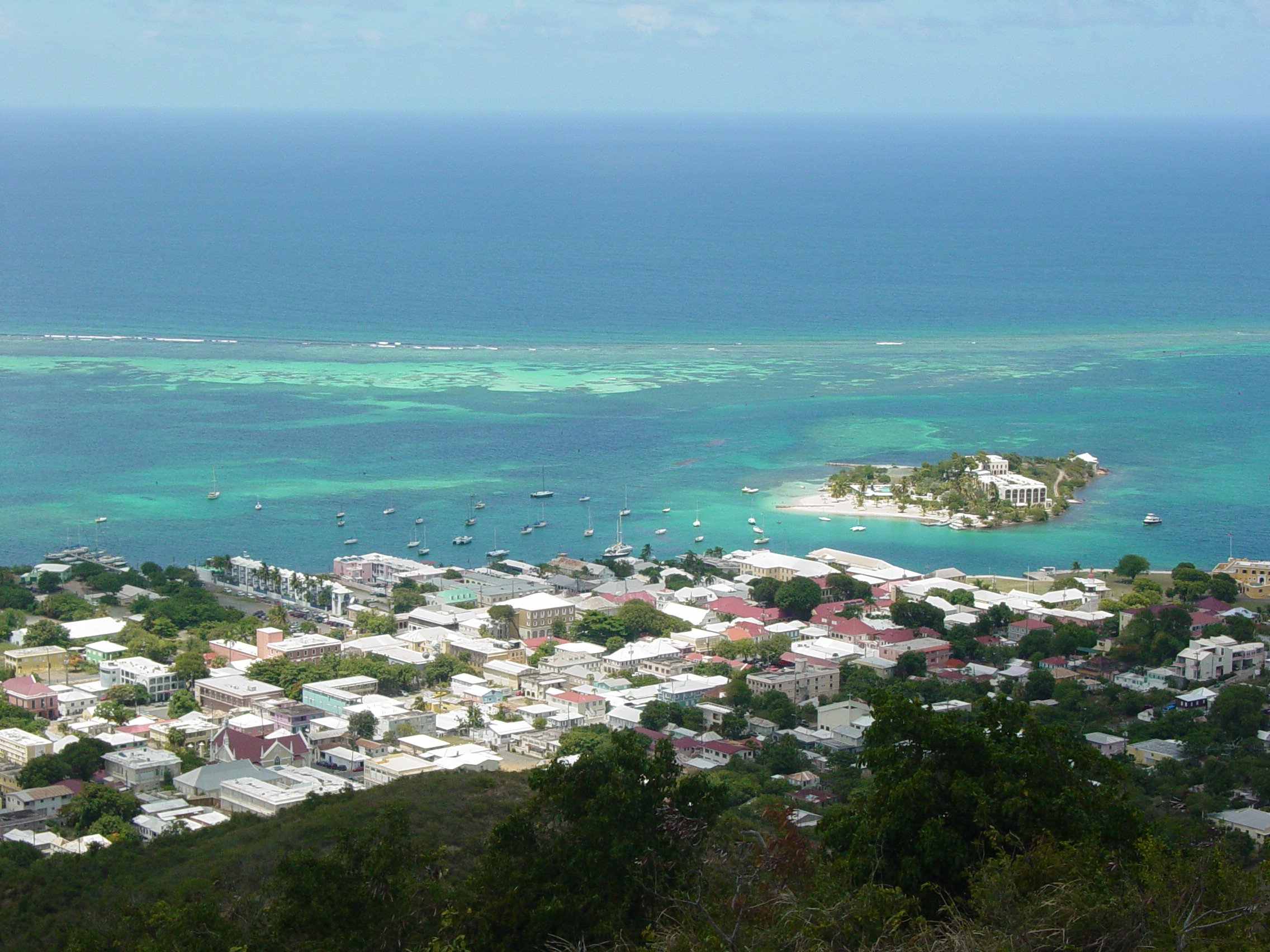
St. Croix is the largest of the US Virgin Islands, and the most historically layered. Where St. Thomas runs on tourism and St. John on eco-credentials, St. Croix has a quieter confidence — colonial architecture, working towns, and some of the best diving in the Caribbean without the crowds.
The main base is Christiansted, a compact waterfront town whose 18th- and 19th-century Danish buildings still line the harbor. Pastel warehouses, a fort, and an old customs house give it the feel of a place that hasn't tried too hard to pretty itself up. The Christiansted National Historic Site covers the yellow fort, the Danish customs house, and the old slave market — the most intact Danish colonial streetscape in the Caribbean. The Danish West India and Guinea Company Warehouse is part of the same complex, an 18th-century trading house whose arched arcade still fronts the harbor. On the western end of the island, the smaller town of Frederiksted has its own fort — Fort Frederik, where Danish Governor Peter von Scholten proclaimed the emancipation of enslaved people in 1848 — and a more relaxed pace.
Just outside Christiansted, Salt River Bay is the only confirmed site in what is now US territory where Columbus's expedition made landfall, in 1493. It's also an important archaeological site — a prehistoric ceremonial ball court, burial grounds, and village middens from the island's indigenous Taíno people — and a protected estuary worth kayaking through at night to see the bioluminescent bay. Offshore, Buck Island Reef National Monument protects an elkhorn coral barrier reef with an underwater trail that works for snorkelers as much as divers. Sea turtles, reef fish, sea fans, and the occasional hawksbill nesting on the beach make it one of the more rewarding half-day trips in the region.
At the eastern tip, Point Udall is the easternmost point in the United States — the first spot in the country to greet each new day. On the north shore, Cane Bay is the island's most famous dive site, with a wall that drops thousands of feet and can be reached directly from the beach. At the southwestern tip, Sandy Point National Wildlife Refuge is the most important leatherback sea turtle nesting site in the United States. In the interior, the St. George Village Botanical Garden occupies a former plantation workers' village, and Estate Whim Museum offers the most complete picture of what a Danish sugar plantation looked like in full operation. The Cruzan Rum Distillery, operating since 1760, is worth a tour and a tasting.