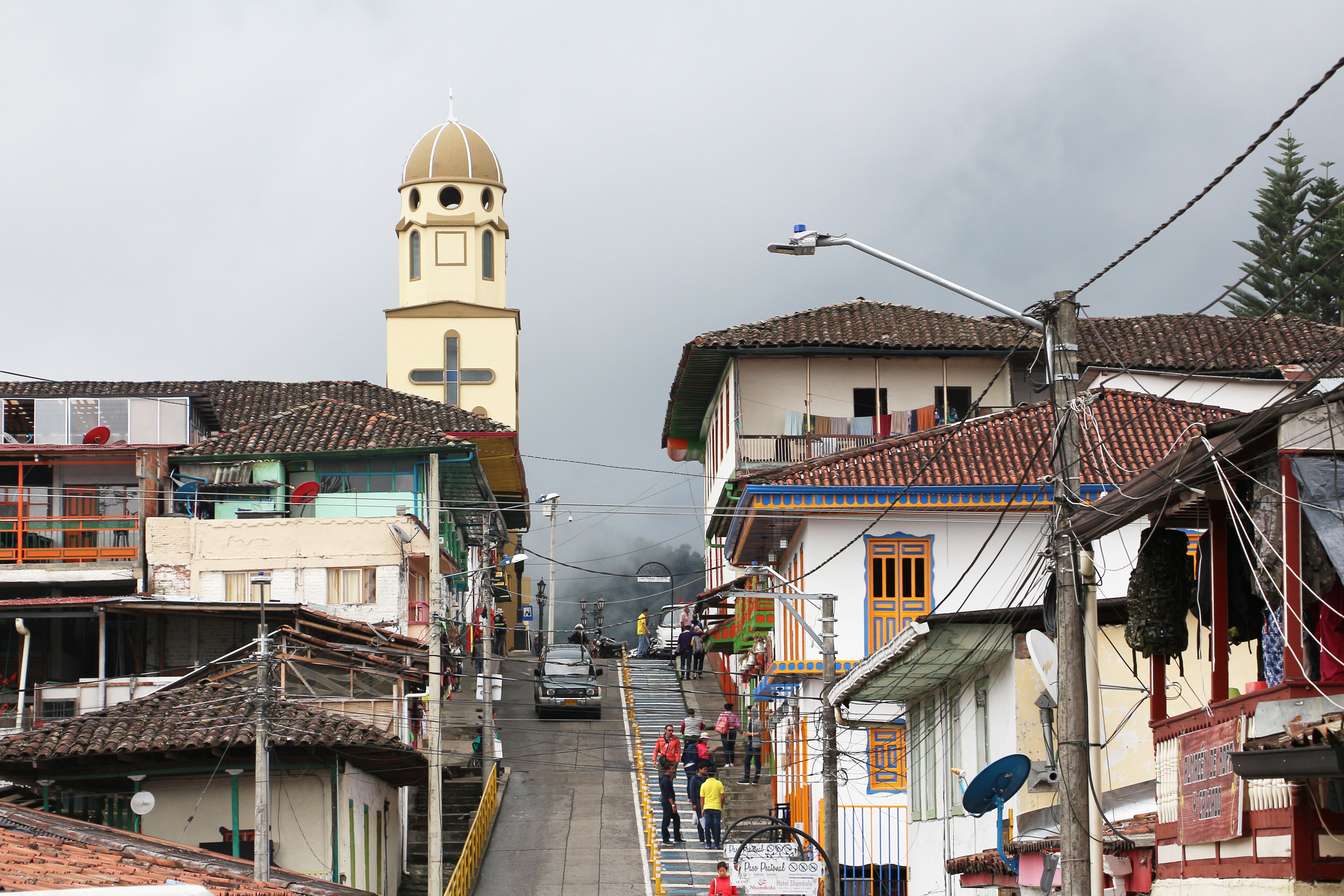
Colourful coffee-country town in the western Andes, gateway to the wax palms of Valle de Cocora.
Salento is the most painted, most photographed, and most visited town in Colombia's coffee country — a small grid of streets on a ridge in the western Andes, painted in bright colours, surrounded by mountains and coffee farms, with the extraordinary Valle de Cocora just a short jeep ride away. It earns its popularity. The combination of handsome architecture, good food, and one of the most dramatic landscapes in Colombia within easy reach makes it hard to leave.
The town itself is compact: a central plaza with a church, several streets of colourful balconied houses, craft shops selling bamboo artesanías, and restaurants serving trout from the mountain streams and the local specialty bandeja paisa. The viewpoint at the end of Calle Real (the main street) gives a panorama across the coffee-growing valleys. But it is the Valle de Cocora — a 30-minute jeep ride from the plaza — that most visitors come for: a valley of improbably tall wax palms (Colombia's national tree, which can grow to 60 metres) rising from rolling green pastures, backed by cloud forest.
Hiking in the Cocora Valley is the headline activity, a 4–6 hour loop through the palm valley and cloud forest with a hummingbird house and a waterfall on the route. The small towns of the Quindío department — Armenia, Montenegro, Filandia — are within day-trip range, as are several traditional coffee farms that offer tours. Salento is particularly popular during Colombian holiday weekends; visiting mid-week avoids the crowds considerably.
Guide
Eating Out
Salento is one of the better places to eat in the Colombian coffee region. The local specialty is trout — farmed in the cold mountain streams — served grilled, fried, or in sauces. Most restaurants on Calle Real offer trout in various preparations. The other regional staple is the bandeja paisa: a platter of rice, beans, chicharrón, chorizo, ground meat, egg, and arepa. Heavy, satisfying, and filling enough to fuel a day's hiking.
The coffee, naturally, is excellent. Several cafes on Calle Real serve specialty espresso and pour-over from local farms, a significant improvement on the instant Nescafé that still shows up in much of Colombia's domestic market. Asking for a tinto (black coffee) will get you a small cup of locally grown, freshly roasted coffee.
Guide
Getting Around
The town of Salento is small enough to cover on foot in 15 minutes. To reach the Valle de Cocora, take one of the Willy jeeps from the central plaza — they depart when full (usually 6 people) throughout the morning and early afternoon. The standard fare is a few thousand pesos.
For visiting coffee farms and the surrounding villages, the jeeps can be hired privately or you can take the regular routes that run to nearby verédas (villages). Ask at your accommodation for current schedules and fares.
Bicycles can be rented from a few shops in town, though the terrain around Salento is hilly enough to make cycling more challenging than on flat land.
Guide
Getting There
Salento is most easily reached from Pereira, 58 kilometres away by road. Several bus companies run direct services from Pereira's bus terminal, taking about 1.5 to 2 hours depending on traffic. Shared taxis (colectivos) from Pereira's La 14 shopping centre are faster and more frequent.
From Armenia (the Quindío capital), frequent buses cover the 30-kilometre journey in about an hour. Armenia has an airport with regular flights from Bogotá and Medellín, making it the more convenient entry point if flying from within Colombia.
From Bogotá, the overnight bus to Armenia or Pereira takes about 8 hours. By air, Bogotá to Armenia or Pereira is about 45 minutes.
Guide
When to Go
Salento's climate is warm and moderately wet year-round at 1,895 metres altitude. The dry seasons are December to January and June to August, when the Valle de Cocora hike is drier underfoot and the mountain views clearer. The wet seasons (September to November, and March to May) bring daily afternoon rain; the trails become muddy and waterproof boots are essential.
The biggest factor in timing is crowds: Salento is enormously popular with Colombian domestic tourists on holidays, and the central plaza and Calle Real can be overwhelmed on long weekends and school holidays. Mid-week visits, even in peak season, are notably quieter. The December-January period is particularly busy; early January after New Year is one of the most crowded times of the year.