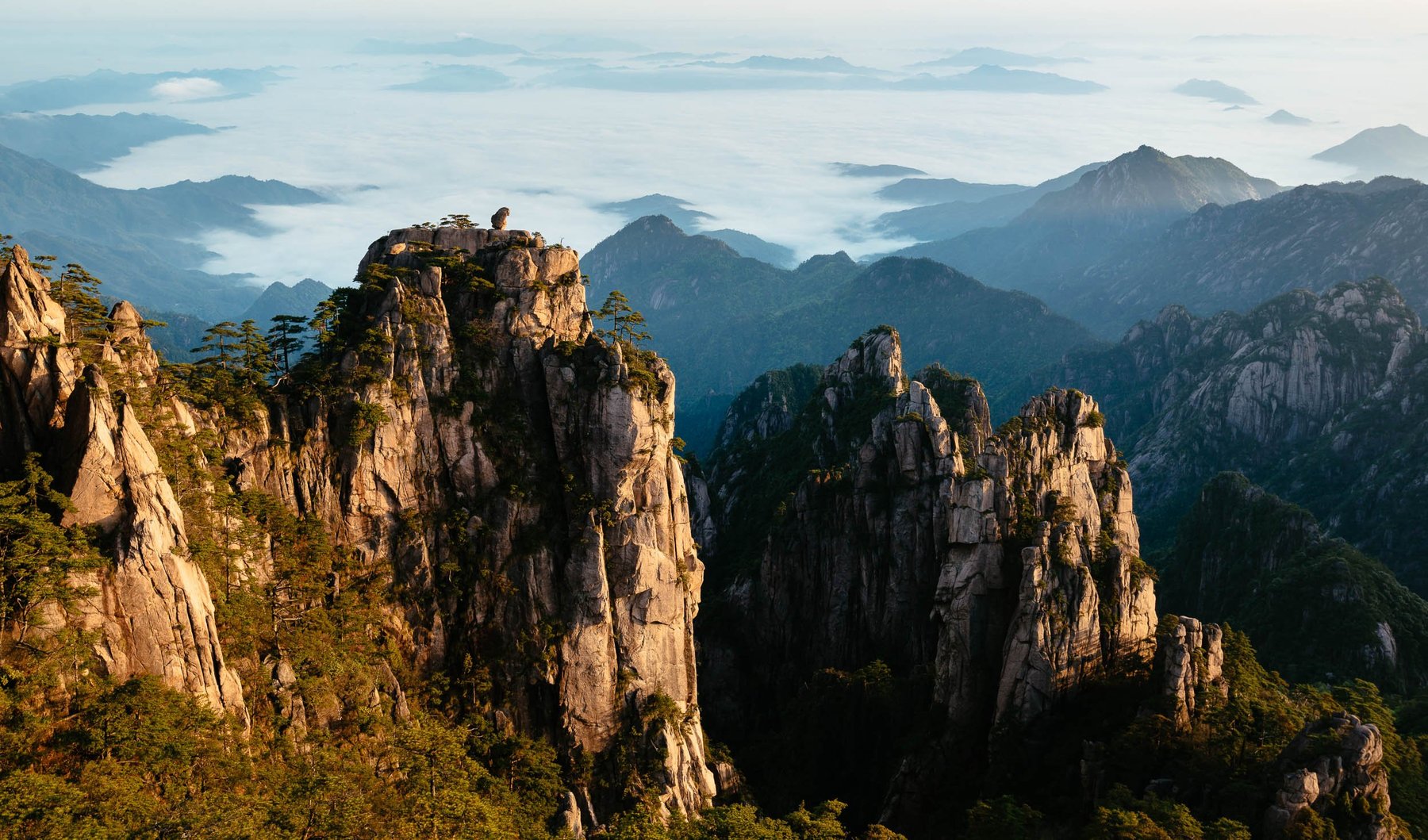
Huang Shan (Yellow Mountain) is one of China’s most celebrated landscapes — a 72-peak granite range in Anhui province, about 400km south-west of Shanghai, that has been inspiring Chinese painters and poets for over a thousand years. The mountain range is famous for four sights: the sea of clouds that forms below the peaks, the twisted pines growing from the cliff faces, the peculiarly shaped granite formations, and the hot springs at the base.
The peaks rise to 1,864m at Lian Hua (Lotus) Peak. Three cable cars serve different parts of the mountain, though the most satisfying approach is on foot — thousands of stone steps wind up through the forest, past pavilions and viewpoints, to the high plateau where the most famous granite formations stand. Many visitors take a cable car up and walk down, or spend the night on the mountain to catch the sunrise above the clouds.
The closest city is Huangshan City (also called Tunxi), about an hour from the scenic area by road. From there, night trains and buses run to Shanghai (around 5 hours by bus, 12 by train) and flights connect to major Chinese cities. The old Hui merchant streets of Tunxi and the ancient villages of Hongcun and Xidi (both UNESCO World Heritage Sites) in the surrounding countryside are well worth a half-day each.