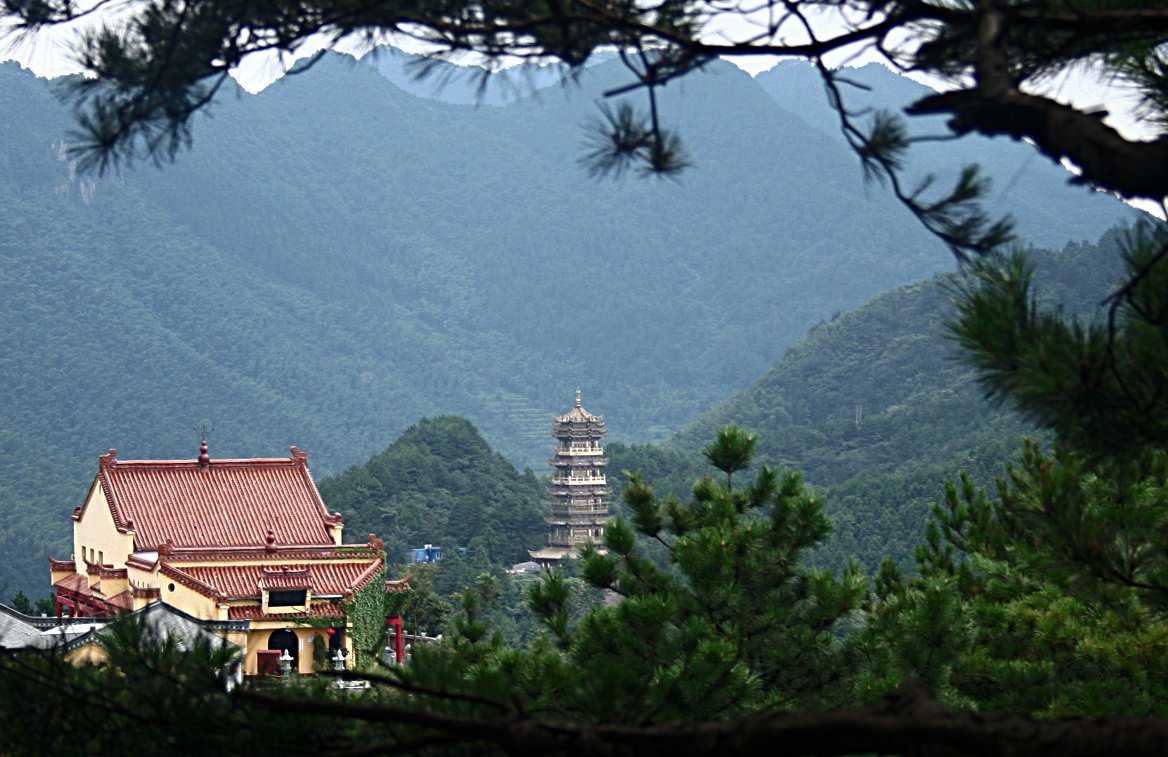
Jiuhua Mountain — Jiuhuashan, the Mountain of Nine Glories — is one of China's four sacred Buddhist peaks, and of the four it is the most closely associated with Dizang Bodhisattva, the protector of souls in the underworld. That specific religious identity gives Jiuhuashan a character distinct from the other great Buddhist mountains: where Wutai and Emei draw general Buddhist devotion, Jiuhuashan is particularly frequented by those seeking intercession for deceased family members, and the atmosphere among the pilgrims reflects this — more solemn, more private, less touristic in feeling despite the significant visitor numbers.
The mountain rises to 1,342 meters in southwestern Anhui, encompassing 174 square kilometers across eleven officially designated scenic zones. During the Tang dynasty over two hundred temples stood on the slopes; around fifty survive today, ranging from small cliff-face shrines to substantial monastery complexes. The main monasteries — Zhiyuan, Huacheng, Ganlu, and Baisui Palace — are all active religious communities as well as historical monuments, and the presence of monks going about their daily routines gives the mountain an authenticity that purely secular scenic areas lack.
The approaches require some determination. There is a cable car to the upper sections, but the traditional route ascends on foot through forests of bamboo and deciduous trees, past way-shrines and rest pavilions, with the monasteries appearing at intervals along the path. The Tiantai Peak trail is the most demanding and most rewarding, passing through the Zhuhai bamboo forest before emerging above the treeline. The mountain has over two thousand cultural relics, including bronzes, calligraphy, and embroidered sutras accumulated over more than fifteen centuries.
Access is by train to Tongling or Chizhou, followed by a direct coach to the mountain. The site is a national natural and cultural heritage area and a UNESCO Global Geopark.