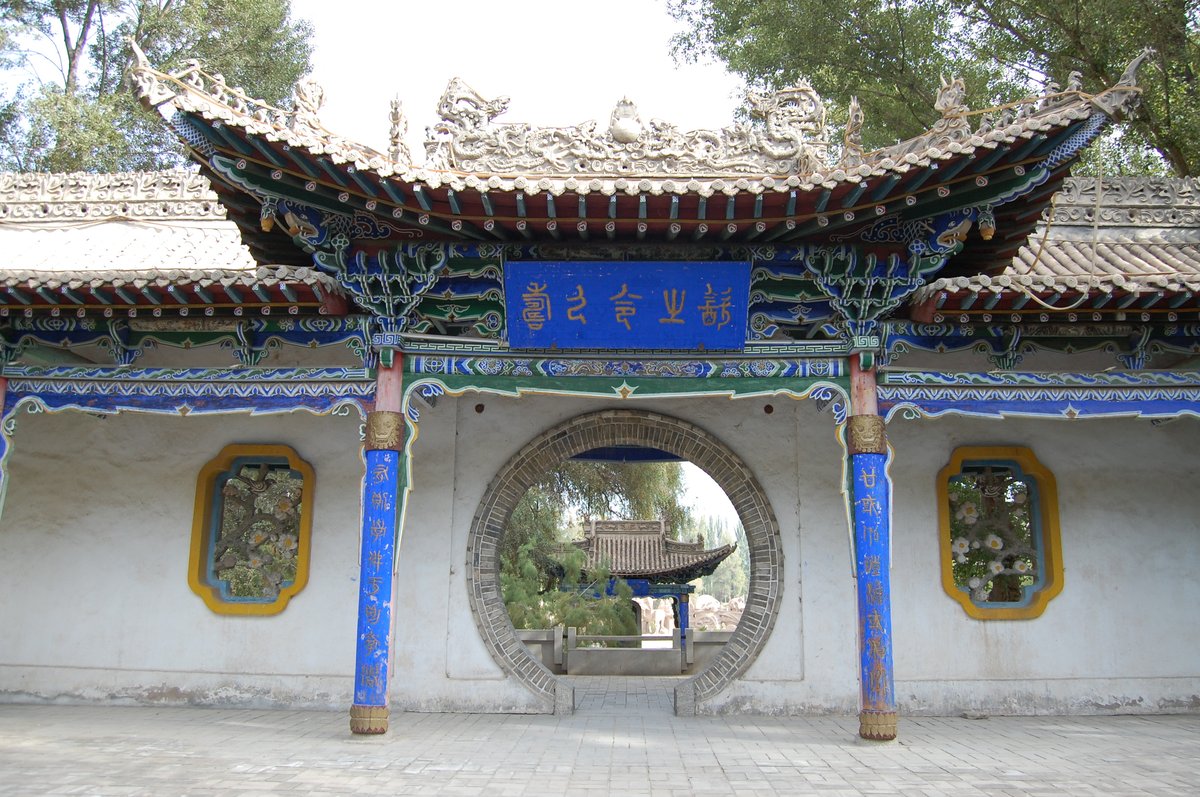
Jiuquan has two claims on travellers' attention that sit at opposite ends of Chinese history. The name itself translates as "wine spring" and refers to a legend in which the Han general Huo Qubing, celebrating his victory over the Xiongnu nomads in 121 BC, poured his imperial gift of wine into a spring so that all his soldiers could share it. The spring still exists, set in a pleasant park near the city centre. The other claim is more contemporary: Jiuquan is the nearest city to the Jiuquan Satellite Launch Center, the facility from which China launched its first crewed spacecraft in 2003 and from which most subsequent missions have departed.
The satellite launch centre itself is not accessible to foreign visitors, but the city's Drum and Bell Tower is one of the better preserved such structures along the Hexi Corridor — a three-storey wooden pavilion on a brick platform, originally built in the fourth century and rebuilt in the twentieth after a fire, standing at the centre of the old city. The Jiuquan Museum, housed nearby, covers the city's Silk Road history and is free. Wine Spring Park surrounds the legendary spring with a traditional garden.
Jiuquan is administratively enormous — it encompasses Dunhuang and Jiayuguan within its prefecture — but the urban centre is a compact and not particularly exciting city most travellers pass through on the way to those more storied destinations. The local specialty is guazhou melons, sweet varieties grown in the dry climate of the western corridor, which are sold from roadside stalls in season and are worth trying.
The city has two rail stations; Jiuquan South handles high-speed trains. Jiayuguan, thirty kilometres west, uses the same Jiayuguan International Airport. Bus connections run to Dunhuang in about five hours and to Zhangye in two.