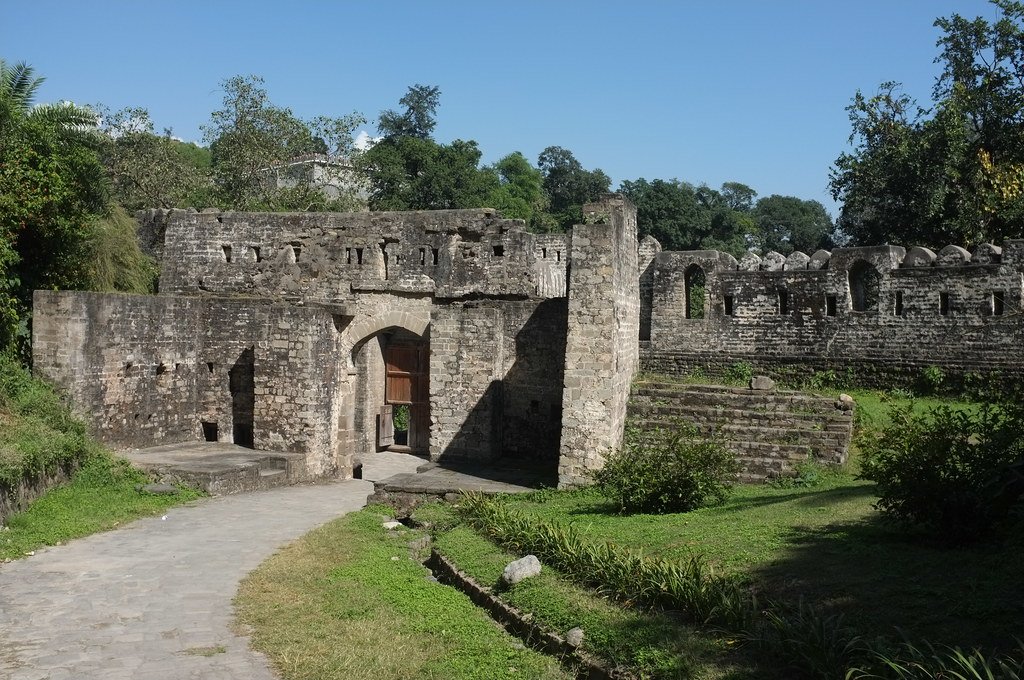
Kangra
©
Kangra

Kangra

Himachal valley town below the Dhauladhar range, with fort ruins and Pahari painting heritage.

Kangra is a small town tucked into one of Himachal Pradesh's most beautiful valleys, just 18 km from Dharamsala. The Dhauladhar range — the "white ranges" — rises to 14,000 ft behind the town like a massive wall, its snow-capped peaks providing a dramatic backdrop to the lush valley below, where pine forests, tea gardens, orchards, and terraced fields roll down in gentle slopes above the Banganga river.

Once the capital of the ancient Trigarta kingdom and one of the most powerful hill states of Punjab, Kangra was known for its magnificent temples and as a centre of Pahari miniature painting. Today the town itself is modest in scale, but the fort and the Vajreshwari Devi temple are reminders of a genuinely impressive past.

The Kangra Fort — also known as Nagarkot or Kot Kangra — sits on a precipitous hill at the confluence of the Banganga and Manjhi rivers, its natural moat formed by the two rivers below. It withstood repeated sieges by Mughal armies and was considered impregnable until artillery made its walls vulnerable. The 1905 earthquake caused severe damage, and the fort now stands in atmospheric ruins managed by the Archaeological Survey of India.

The Vajreshwari Devi temple, one of the most revered Shakti shrines in northern India, draws pilgrims year-round. The main temple, destroyed by the 1905 earthquake, was rebuilt in 1930; its three domes are said to reflect the architectural traditions of Hinduism, Islam, and Sikhism — an unusual gesture of syncretism. The valley as a whole, known as the Kangra Valley, is worth exploring for its landscape alone.

Guide

Getting There

Kangra sits on NH 20 and is well connected by road to the rest of Himachal Pradesh and the Punjab plains. The town is 18 km from Dharamsala, 222 km from Chandigarh, and around 510 km from Delhi.

Regular bus services link Kangra to Dharamsala, Chandigarh, Delhi, Dalhousie, Jwalamukhi, Jammu, Kullu, Manali, Mandi, Palampur, Chamba, and Shimla. Deluxe and luxury coaches from Delhi and Manali pass through on NH 20; the bus terminus is on the main highway. Local taxis, jeeps, and shared vans are available for shorter runs within the valley.

The nearest major railhead is Pathankot (88 km), which has connections to Delhi and Jammu. A narrow-gauge Kangra Valley Railway runs from Pathankot to Jogindernagar, passing through Kangra town — a scenic route in itself, though slower than road transport. The nearest airport is Gaggal (Kangra Airport), about 15 km from town, with flights to Delhi.

Guide

Things to Do

Kangra's main draws are its fort and its temple, two of the most significant historical sites in the western Himalayas. The fort stands on a precipitous spur above the river confluence and offers extraordinary views of the Dhauladhar range; the Bajreshwari Mata temple draws pilgrims year-round as one of the most revered Shakti shrines in India. The Kangra Valley Railway — one of the most scenic narrow-gauge lines in the country — connects the town to Pathankot and Jogindernagar and is worth riding for the landscape alone.

Guide

When to Go

The best time to visit Kangra is from October to June. The post-monsoon months of October and November offer clear skies and fresh air after the rains have washed the valley, with the Dhauladhar peaks crisply visible from the town. March to June is warm and pleasant, with the apple and cherry trees in bloom in spring.

The monsoon arrives in late June or early July and lasts until September. This period brings heavy rainfall, frequent landslides, and disruption to mountain roads. The valley is lush and green but travel becomes difficult and the fort ruins become slippery. Winter (December to February) is cold, with occasional snowfall in the upper valley, but the weather is generally stable and the crowds thin out considerably. Kangra town itself rarely sees snow, but the Dhauladhar peaks are white throughout winter and the views are exceptional in clear weather.