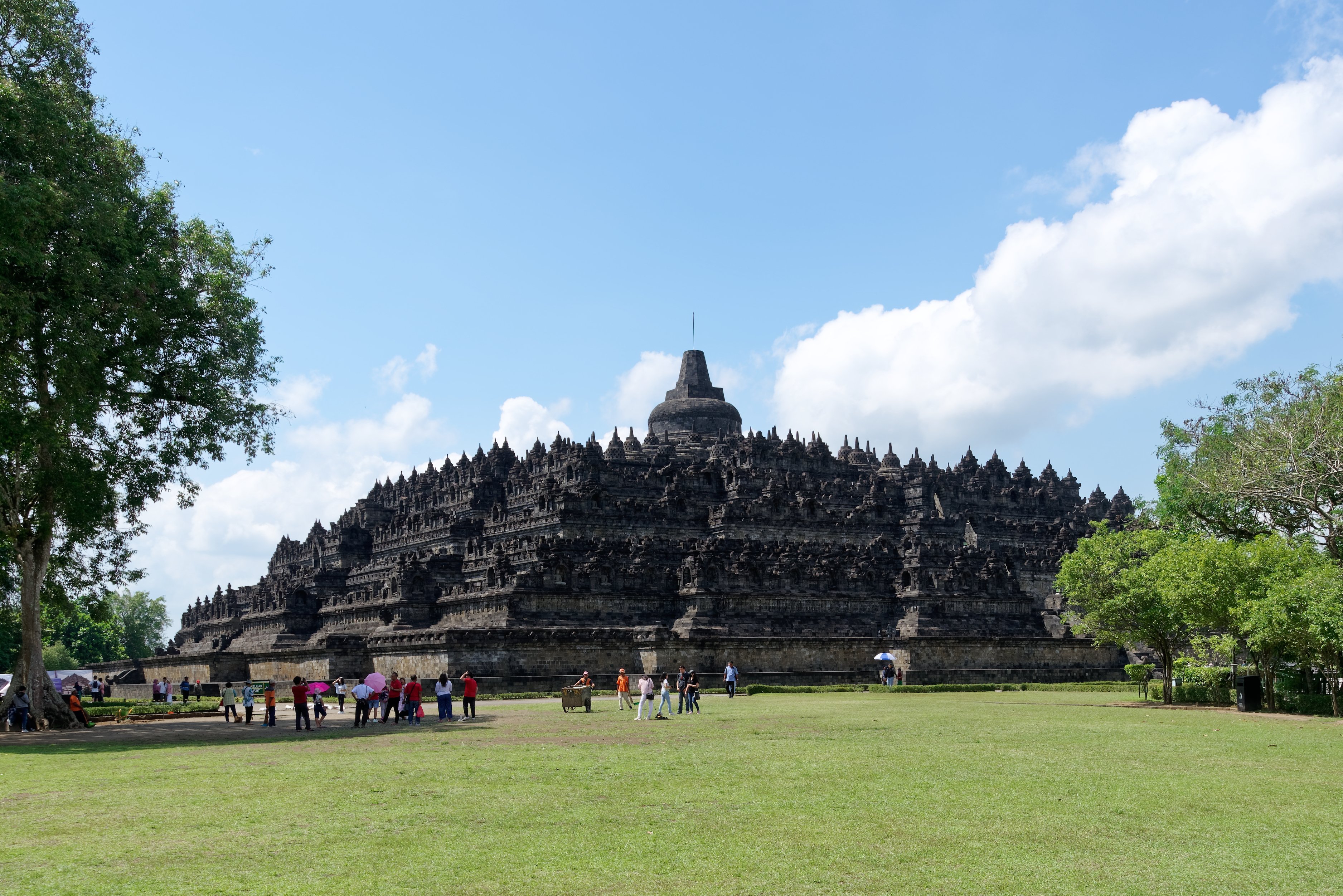
Borobudur is the world's largest Buddhist monument and one of the greatest architectural achievements of Southeast Asia. Built in the 9th century by the Sailendra dynasty, this UNESCO World Heritage Site rises from the fertile Kedu Plain about 42 km northwest of Yogyakarta, its ten terraces stacked in a stepped pyramid of stone. The name derives from an Old Javanese expression meaning roughly "mountain of accumulated merits."
The temple is simultaneously a monument, a mandala, and a pilgrimage route. Walking the galleries from the base to the summit — about 5 km in total — takes you through 2,672 carved relief panels narrating the life and teachings of the Buddha. At the top, 72 perforated stupas each contain a seated Buddha figure, and the great central stupa rises above them all. The view from the summit across the Kedu Plain, with volcanic Mount Merapi and Mount Merbabu framing the horizon, is one of the most memorable in Java.
The temple was buried under volcanic ash and jungle for centuries, rediscovered during the British colonial period in the early 19th century, and painstakingly restored. A major UNESCO restoration in the 1970s and 80s dismantled and reassembled much of the structure stone by stone. The site is open 6am–5:15pm; it is most spectacular at sunrise, when mist fills the plain and the summit temples emerge above the clouds. Plan to be at the top platform by 5:45am if you want sunrise without a crowd.
Three kilometres east stands Mendut Temple, with an extraordinary three-metre-high seated Buddha — traditionally the start of the processional route to Borobudur. The curious Chicken Church (Gereja Ayam), a giant bird-shaped prayer house built in the forest about 2 km west, has become an unlikely local attraction.